Home Blog Page 59

Who’s Better for the Economy: Ordinary People or Billionaires?

A war on wealth has begun. In the UK, its the Labour Party’s dogwhistling. Our American cousins face the rise of Alexandria Ocasio-Cortez , Ilhan Omar, Elizabeth Warren’s proposals for a wealth tax in the U.S., and Bernie Sanders’ Modern Monetary Theory and New Green Deal.

In France, they had the Gilets Jaunes, labelling Macron “President of the Rich” as they torched luxury cars and shops on the Champs-Élysées. Then, when France’s billionaires donated their millions to re-build Notre Dame, the same movement criticized them for not donating to other causes. We are in the midst of a war on wealth because of wealth.

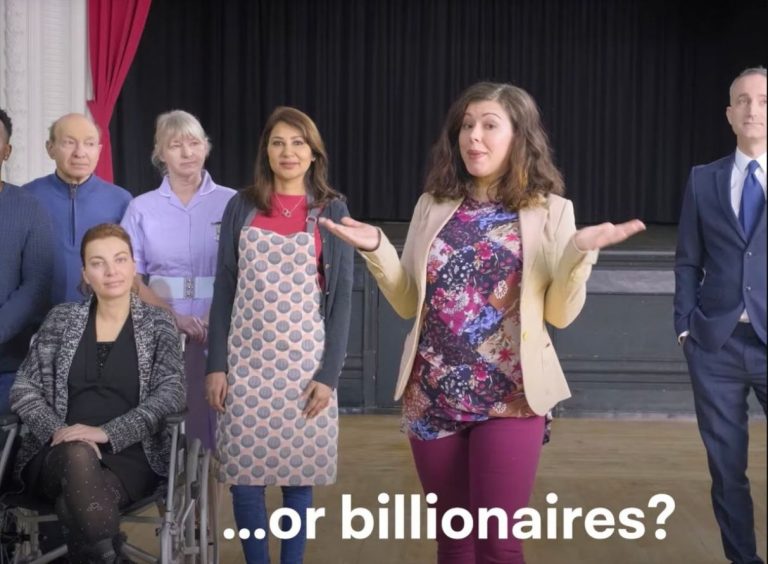
The Labour Party’s latest broadcast (below) shows how a billionaire would spend (or not) a tax cut of £20,000 versus how their government would reallocate that money to student grants, pension and wage increases which is then in the hands of individuals to spend in the economy to generate economic growth. It poses the question in its denouement: “Who’s better for the economy. Ordinary people or billionaires?”

Whatever your political viewpoint, it’s not hard to see why someone may be anti-rich. Global inequality, according to a report by Credit Suisse, has increased since 2008’s Great Recession, with the top 1 per cent of global wealth holding 42.6 per cent of all household wealth in 2008. This shot up to 47.2 per cent mid last year.

While this may seem problematic, the rich aren’t to blame for the recession, but central bank policies, in particular the ECB. Witch-hunts find it easy to scapegoat the wealthy throughout history that aren’t easy to comprehend. It doesn’t help when Labour politicians feed these narratives of the wealth gaps, rather than address poverty as the evil, not wealth.

Imagine the scenario: you have built a successful business, played by the rules and made lots of money. The public then decides you have more than you need so decide to rob you of your labours. Because of this threat, many wealth are curbing their ostentation, and keeping a low profile. The rich today try not to look rich, let alone talk about it.

Labour’s Virtue Signalling

The problem with the video besides its tenuous links to economic reality is the tendency to incite resentment toward wealthy, singling them out from the rest of us. All the while, blaming them for the economic issues and claiming they don’t value money: “Oh, that money, I completely forgot all about it!”

A Labour government will re-nationalise economic sectors they think they can manage better, increasing employment and improving pay, reinvesting profits in Britain with no need for these flitting billionaires.

But what would make Labour better placed than the private sector to offer quality services? People are quick to forget the absolute state of them before privatisation. And because we had been protectionist, nationalised for so long they simply couldn’t compete with international competition.

Billionaires employ tens of thousands of people. But why would it be a good idea to keep them situated here in the UK?

Rawls and Picketty to the Rescue

Rawls and Picketty insist on redistributive programmes being implemented in a closed society. Otherwise they would be unsustainable, for instance, exodus of the more internationally-mobile rich. In other words, they have to outlaw tax competition and stipulate ‘Socialism in One Country.’

This doesn’t lift up the poor. It brings down the rich. 

For Piketty, wealth seems to be the social evil, not poverty. Poverty has been greatly reduced in recent decades and new money has replaced old amongst the rich. 

These narratives of runaway accumulation of inherited capital simply aren’t plausible. That’s the beauty of modern market economics. The maligned rich perform useful functions without necessarily intending to do so. 

This idea of wealth statuses being something unearned through rape pillage and plunder in Europe isn’t widely held in the States. And look at the result, we are all in the bottom 3 US states. 

Little wonder Labour broadcasts are virtue signaling. Vilifying wealth because of their wealth, with no consideration for causality. No attention to system design under Lemon socialism – privatised gains, collectivised losses. 

Ideologically perverse motivations to capitalise on Brexit shambles by the Labour Party. The circulating of funds through the economy with lower taxes for small businesses, struggling entrepreneurs who can then work and employ people will make the difference. 

On the other hand, those billionaires who have justly earned their money not by government exclusive contracts to allow for monopolised profit extraction, should be thanked. 

Most nations with a developed financial system allow for capable functioning despite debt. Many of the most materially wealthy individuals are incredibly indebted as they fuel their investments (especially in a low interest world) through taking on debt. 
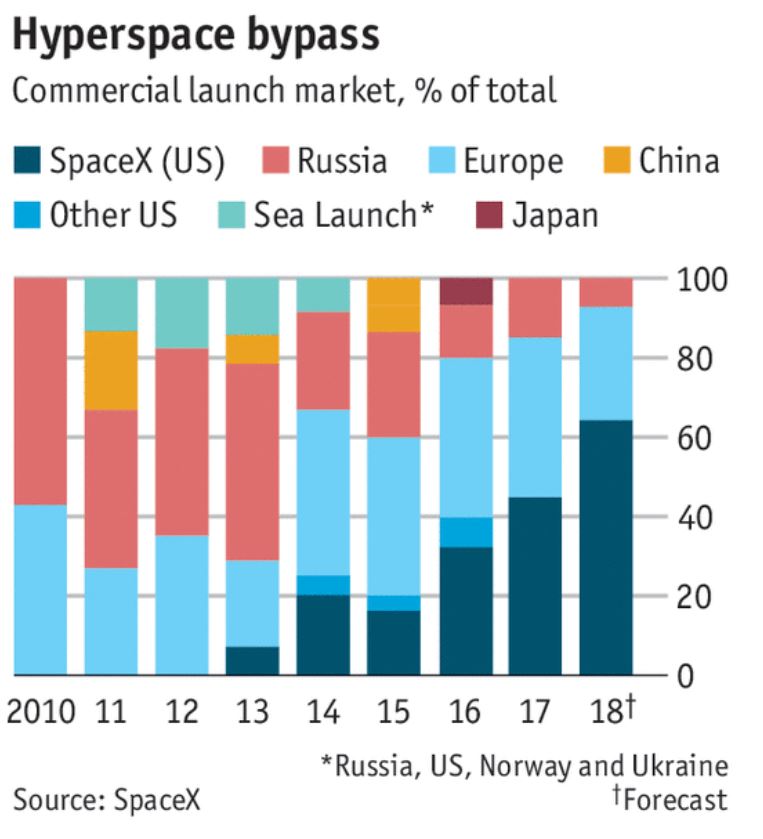
Musk’s Space X stole market share from the Russian Roscosmos State Corporation & Co with relaunch-able rockets – Introducing a little private enterprise to Space // Economist

Look at Elon Musk’s vision for electric cars, for 6 years he has borrowed hundreds of millions against his own shares to pour into the vision. And now he’s ploughing everything into Space X to break up the NASA and Russian satellite launching and space exploration industries with free market competition. Effectively putting his competition out of business (had they not government prop-ups for national interest). 

These billionaires are like the rail barons of old- burning through their great wealth to pioneer new, exciting industries – driving the human face forwards and creating real wealth through the value they provide by virtue of the fact people are willing and prepared to pay handsomely to reward them.

Take JK Rowling’s Hary Potter (a favourite anecdote of Yaron Brook). People have made her a billionaire because they valued her stories and magical world more than they valued a few pounds here and there. Or the iPhone XS, are people really being coerced by advertising / marketing alone to part with 1200$ or do they believe it will give them more value than their 1200$ in their pocket? 

Or the Sam Walton’s with their Walmart’s saving consumers money by driving down prices. Then they have more disposable income to spend elsewhere, or save – I know, a novel concept for Keynesian drones. 

The reality is, this mentality makes everybody poorer. And we would end up with a basket case economy where to get ahead of other people power is sought in politics and then they grant themselves exclusive rights to an industry (Brazil) or appropriation of businesses (Serbia).

Much of the western world, with free markets, entrepreneurialism and hard work + significant risk – be it time, capital or taking on loans – are how people get rich and create wealth for others by innovating to solve problems in society that other people are prepared to pay money for. 

Wealth is endogenously created and not restricted, despite central bank efforts. My having it doesn’t not decrease the size of the pie available to you as there is no fixed pie. Wealth is not at the expense of others. It can be destroyed though, take Bastiat’s broken window fallacy illustrating why destruction and the money spent to recover destruction is not actually a net benefit to society. 

Wealth is created in exchange for creating value. Labour going into products or services only has value if something is willing and able to pay for it. Otherwise, what would you tell the entrepreneur who put in 10,000 hours and didn’t see a single penny? Should we bail them out according to his ability, to each according to his needs? 

Trillions of dollars aren’t stuffed in mattresses as the video suggests the billionaire with his tax cut just pockets the money and forgets about it. It’s invested, either via ownership of capital assets or via financial institutions. New businesses are funded creating jobs and products for consumers, or it is used to finance household debt for mortgages and other consumer purchases. 

The wealthy often have businesses and ventures themselves. They take in lots of debt to finance projects they believe will generate growth of capital or provide a solution they can sell and make profit.

It could be new infrastructure, technologies or arbitrage opportunities that assist in clearing market inefficiencies more swiftly. 

Wealth may nominally be in the possession of billionaires. But its use is restricted to normal economic functioning which demands everyone consume and interact with their wealth. If they did not provide value, why are we parting with our hard-earned cash to help them ? 

This presentation of ownership as necessarily exclusionary is largely inaccurate for England. 

One merely has to look at Lord Sugar’s cheque to HMRC to see what a billionaire who employs thousands does. One of those who the Corbynites said they can’t wait to appropriate their wealth even though he among others like John Caudwell, creator of Phones4U and Britain’s largest taxpayers, said that they will leave the country in the event of a Labour government under Corbyn. If that comes to pass, and it’s not empty rhetoric, those ordinary people in this advert may have to make up the shortfall in tax revenues.
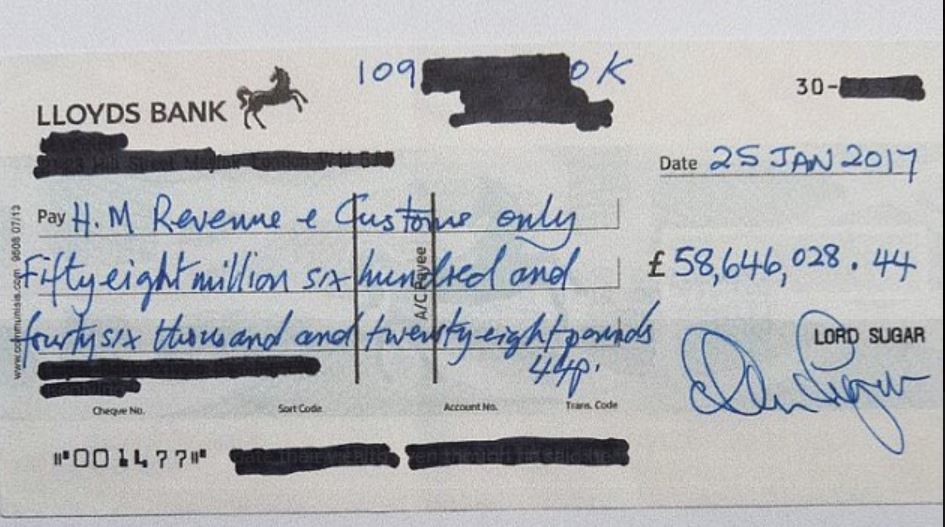
Lord Sugar’s cheque to the taxman 2017. Source: Daily Mail

Baseless Agendas Leading Voters up the garden path

The video has lots of straw-man arguments that are somewhat befitting of their agenda. If reality doesn’t line up with your beliefs, just make baseless assertions. It’s rather telling when tax cuts are presented as government giving people money, instead of the reality of them taking less. Unless you remember the taxman working those 40 hours last month with you?

Labour Government: Chief Judge, Jury and Executioner – A Tale of Inefficiency

This notion a government ministry can adequately allocate and redistribute some hand-outs -instead of doing this hypothetical tax cut (corporation tax perhaps) – and this will solve a slowing economy by itself doesn’t hold much water. Money changing hands increasing the flow in the micro-economy is beneficial for providing more liquidity which helps consumer confidence, but it isn’t better for the economy than entrepreneurs and pioneers who create real wealth by solving problems we face through brainstorming ideas and then implementing them. Innovation, then, through taking on risk, debt and working incredibly hard trumps this stagnating, sustain the status quo drivel we are fed by political virtue signalling.

The trouble with this simplistic “tax the rich!” jargon so routine workers can then enjoy a better life is it would encourage stagnation.

If you’re happy sitting where you are that includes being happy with what you’re paid. If you’re willing to be an employee at that wage then great as companies need steady, complacent workers. If you’re not, however, and want more to improve yourself, work hard and promote upwards, then great also.

This idea that some who have bettered themselves, risen through businesses or created their own and are making money can then be taxed sufficiently to have ANY noticeable effect on the average workers quality of life is a mathematical improbability.

There are simply not enough rich people and there are far too many idle people with hands extended to rob them of their earned money, put it in the governments hands where inefficiencies piss away 80% into white elephants and hand out the remaining funds to millions of people. Often providing the funds to attend courses and degrees that don’t teach them the needed skill sets to make them useful for working in businesses. The miss-allocation of resources that allows for people to undertake degrees they wouldn’t risk doing if they had their own £30,000 of capital on the line, instead without any real risk of having to pay those loans back to taxpayers – clean slate after 30 years – is nonsensical.

The reality is, a Corbyn government would want to keep large swathes of the population in their place so they’ll vote for those generous overlords to keep the handouts coming. It’s far more expedient than working for it after all. And the government can keep printing money or plucking it off the magic money tree without damaging the UK’s credit rating. It’s bound to all end in tears and conveniently we can just blame those remaining rich people who stuck it out and continued working hard developing businesses while the rest fled overseas.

The Maths Doesn’t Add Up

Take the top 10 US billionaires. We can assume net income at 5% of their net worth. For instance, Bill Gates takes in ~$4 Billion. Applying this factor across the 10 richest, we have 26 Billion dollars a year.

Now let’s add a new tax to that money. 10% off the top to Government will be 1.3 BN 

Now take 321,400,000 American citizens. Assume 60% qualify for your wealth distribution programme with the 40% above rich enough arbitrarily. Some of them may have tried to get rich but failed, tough luck, not enough for everybody. 

160,700,000 people have a slice of $1.3 Bn . 

Congratulations , you have a life changing cheque for $8.14 courtesy of the generosity of your 10 Richest people that inequality campaigners lark on about. 

Oops, sorry. This is before government inefficient handling of the redistribution takes its chunk. 80% is the general rule of thumb for revenues that is consumed by the machine. So 20% left for social programmes. Even if Trump whopper government into shape and we saw 40%. This is a measly $3.25. 

We have only taken from the top 10, how about the others? Well, wealth drops off going down Forbes 400 from $80~ Billion down to 1.7 Bn. With far more single digit billionaires than double, median net worth stands at 3.6 Bn. 

Doing the same math as above, you would receive $353.25 from the entire Forbes 400.

Now, I don’t know how much more money you think you deserve, but you can see that you would have to work pretty far down the “Rich” lists before you’re going to get to you making another $10,000 a year more. And the case in question in the U.K. with our considerably fewer superich is significantly raiding the upper middle class of the family silver and while you’re at it make sure you get the crockery too. 

The simple mathematical answer is, like with all socialist policies there are simply not enough rich people to pay for all the non-rich people’s fantasies. Especially not after glacial bureaucracy and ballooning government inefficiency margins. 

Besides, then, creating a system of dependency, it encourages people to be idle and comfortable in their relative poverty. Rather than actively impelling oneself to take personal responsibility and find solutions to problems we all face or get the skills necessary to be useful in the modern economy.

The moralistic answer is why should people expect to be allowed to sit where they are and paid more money that comes from other people who have earned it? Let alone the incredible leaps and bounds for humanity’s benefit those dreamers and high achievers can accomplish without coercive intervention, whether intentional or their part or otherwise.

For Labour’s concept of a magic money tree or this “Modern Monetary Theory” to work, the number of Brits to be taxed would be huge in relation to the number of people receiving the money. Just ask any breadwinner of a household supporting their family, they’ll tell you how hard that is to do. It’s simply not right.

There isn’t generally a good reason why most people can’t make the sacrifices to secure their financial positions. 

There’s too much entitlement, impatience and envy in this country and Europe for that matter with an obsession for tales of Robin Hood than the glorious risk – taking of our Atlantic cousin’s Robber Barrons. 

The sooner we wake up and smell the coffee, we can move away from this socialism quagmire that has stagnated swathes of the globe for decades, and move away from the true evil ‘poverty’ which has plagued mankind as the naturalised state of nature forever. Innovating our way out of the challenges in the 21st century. But this isn’t how you do that.


Don’t bite the hand that feeds you, Marks and Spencers LGBT Sandwich sparks row

The appropriation of minority groups’ struggles in society continues as major supermarket retailer Marks & Spencer release the LGBT sandwich in solidarity with those of the LGBT community.

The supermarket retailer will be donating to charity as well cementing its purposeful attempt to help the LGBT commnunity.

The brand is giving £10,000 to Akt, an LGBTQ+ youth homelessness charity and €1000 to BeLongG, an Irish youth service, although Piers Morgan strongly detested such a notion.

Dont bite the hand that feeds the LGBT community

For something as disposable as a sandwich, you pick it up open, eat, digest and then forget, I wonder truly how much meaning it has behind it. The colours are well known and immediately resonates with those in the LGBT community.

For the LGBT movement to be reduced to a sandwich in the name of unity, highlights the fickle attempts by retailers such as Marks and Spencer’s to stay relevant in a turbulent social justice market.

Food is a momentary pleasure, a sensation that does not last more than a few seconds. It comes and goes. Business is also business and these companies are looking to make money. The capitalist nature of this attempt at solidarity hasn’t gone unnoticed. Witty comments have surfaced on Twitter by one user “Louis Staples”

LGBT people: “it’d be nice if people could stop abusing us when we hold hands in public, we could teach LGBT lessons in schools and if the BBC could stop debating our existence on live air that’d be grea-
Capitalism: “what we’re really sensing here is you want your own sandwich”

Capitalism renders these messages insignificant through making it a commodity in the market. Bought and sold, it makes the movement for LGBT rights tangible and something meaningless.

Feminist thought leader bell hooks argues that such commodification strips political integrity and meaning, making it no longer a possibility to serve as a catalyst for concrete political action. Consumers may ignore political messages.

Feminist author and social activist, bell hooks, discusses the intersectionality of race, class and gender to a full theatre of students, Sept. 20, at the Sorensen Center.

However, if companies are apathetic to the fight for the minority groups to have equality, society will complain.

What we see here is an ongoing trope of companies, organisation jumping on a bandwagon. Its part of the changing market and the way capitalist endeavours are making money in this social justice generation. Companies are now being ethical to align their beliefs with minority groups.

Where is the black lives matter, or even Muslim sandwich? Or a sandwich for gay Jewish vegans perhaps? Perhaps it’s time companies walked back up and stayed out of politics.

Sajid Javid’s Utopian Britain

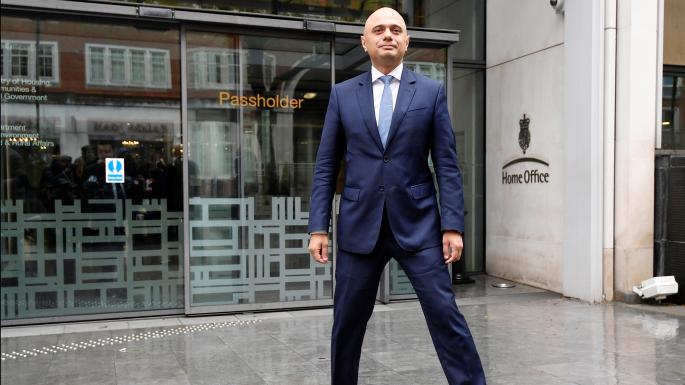
Sajid Javid is a British politician and a former Managing Director at Deutsche Bank. A member of the Conservative Party, he was appointed Home Secretary on 30 April 2018. He has been the Member of Parliament (MP) for Bromsgrove in Worcestershire since the general election of 2010.

On Friday 10th May, Javid told “Political Thinking presenter Nick Robinson he had come to expect social media abuse”. He was quoted as saying: “I get it from the far left, including lots of Asians, who say: ‘He’s not brown enough.’ I get it from the right, and the far right in particular, saying: ‘He’s too brown,'”.suggesting the these moments implicated that the UK was “not ready for a Muslim PM”.

The Home Secretary then went on to refute the racial comments by stating: “I think in Britain, anyone who is capable, regardless of whether they are Muslim, or Hindu for that matter, or any religion – or no religion – can be prime minister.” 

“There are some forces that wouldn’t like that but I think the forces against that are much, much stronger. And if you look around the world and you compare Britain to other leading industrial democratic countries, we are way ahead.”

There are two ways Javid’s statement to Buzzfeed can be interpreted. The first being the Javid genuinely believes that given the blatant racism of the UK is easy to overcome regardless of all the red tape and underlying restrictions facing people of colour and ethnic minorities on a daily basis. Or he is simply playing the role of a politician and feeding us a utopian perspective of Britain. Either way, it can be deemed as naive to believe that simply anyone can become even a politician let alone Prime Minister and this is self-proven given the ethnic and gender make up of the House of Commons.

According to Parliament.uk, ” 8% of MPs in the House of Commons and around 6% of Members of the House of Lords are from an ethnic minority background”. In addition, results from the 2011 UK census, 13.3% of the population in greater London are Black / African / Caribbean / Black British people, 18.4% Asian and 59.8% White. The most recent estimate from the Office for National Statistics (ONS) Annual Population Survey 2016 reported that 13.6% of the UK population is non-white.
The Home Secretary’s belief that anyone, regardless of their ethnicity, experience or religion, can become Prime Minister is limited by these statistics to simply a pleasant sound-bite.

On the contrary, the 2017 general election provided the most diverse Parliament yet. The number of ethnic minority female MPs in the House of Commons increased from 3.0% in 2015 (20 of 650) to 4% in 2017 (26 of 650).

According to BBC News, “the general election of 1987 saw the first ever black MPs voted into the House of Commons. Fast forward 30 years and the 2017 result has seen 52 ethnic minority MPs elected, of those, 32 are Labour, 19 Conservatives and one Lib Dem. It is an increase from 41 in 2015 and the highest number ever”.

Though Sajid Javid’s comments to Buzzfeed seemed to come across as a far-fetched utopian wish, there is an undeniable increase in representation in Parliament that increases the possibility of this wish becoming true. 

Is the English Premier League the Most Competitive in the World?

0

By Kay Ajibade

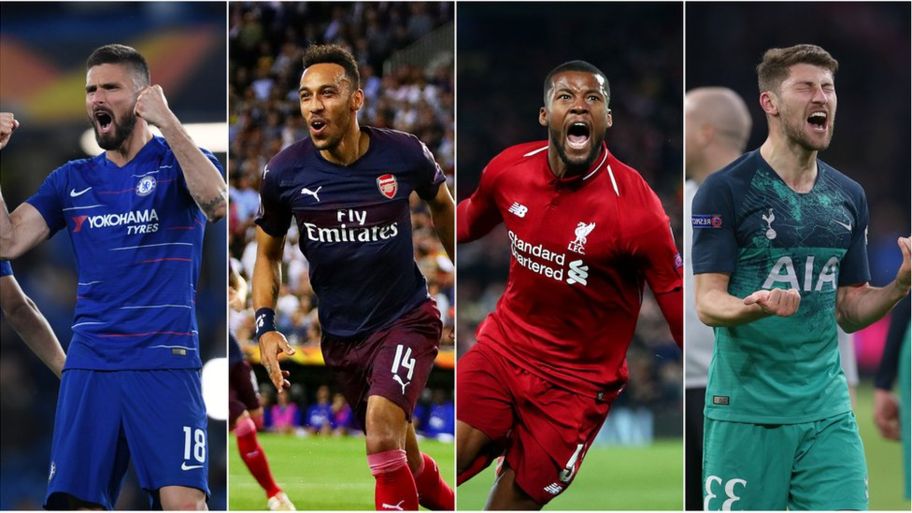
It’s a Full English in Europe this year, with Liverpool appearing in their second Champions League final in two years, they face off with Tottenham Hotspur, whilst Chelsea face Arsenal in the second tier European final.

A Premier title race to remember

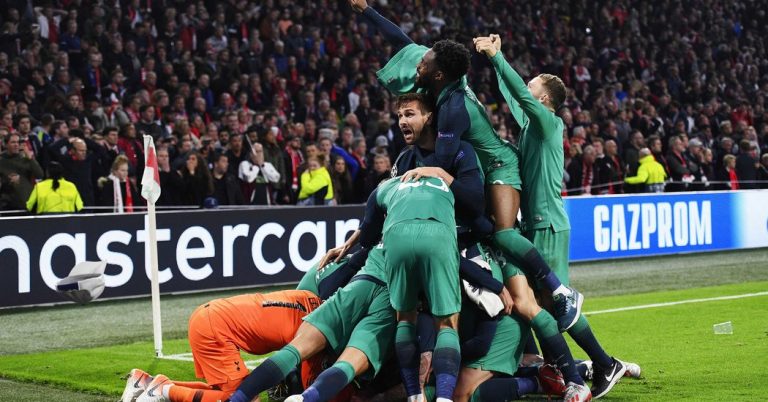
English clubs have created European football history by taking all four final spots in the continent’s two major competitions. There have only been two all-English finals before, with Tottenham beating Wolves in the 1971-72 Uefa Cup and Manchester United beating Chelsea in the 2007-08 Champions League, however across both tournament’s it’s never been done simultaneously.

English teams not affected in Europe by Brexit woes

This year’s title race was relentless between Manchester City & Liverpool, with City emerging victorious. The top two amassed 195 points – a top-flight record for the champions and runners-up. The battle for the top four was fierce, with Champions League qualification at stake, Arsenal, Chelsea, Manchester United & Tottenham fought a tense battle with Spurs & Chelsea clinching the final spots.

That’s just it: the competition in the league this year has served English clubs well and reflected in their European campaigns. In France’s Ligue 1, PSG have again run away with the title, to nobody’s surprise. However, the lack of competition domestically has been noticeable over the last few years and as a result harmed them in Europe.

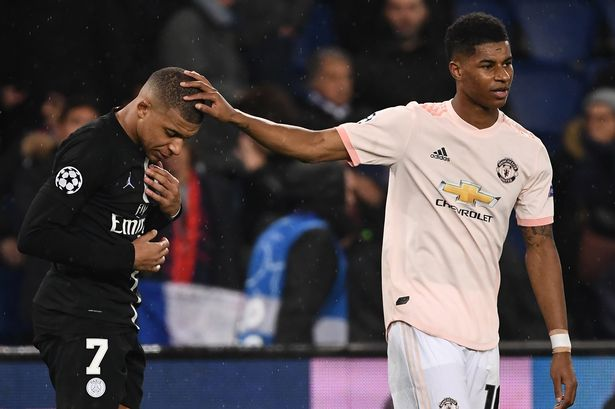
A struggling Manchester United were able to overturn a first leg 2-0 loss at home to comeback and beat PSG at Parc des Princes. Admittedly, the VAR decision that gave United the winning penalty was highly controversial, but the Ligue 1 champions never looked convincing against lacklustre opposition.

Marcus Rashford consoles Kylian Mbappe after United’s injury time win against PSG. Source: Manchester Evening News

In Italy’s Serie A, Juventus retained the league title by 13 points, their eighth consecutive title: again to nobody’s surprise. In Europe however, this time last month, an exciting Ajax team knocked the Old Lady out of the Champions League, winning the decisive leg 2-1 in Turin. Yet again the lack of competition in domestically has been detrimental to non-domestic football. Italian football at the moment is a far cry from it’s glittering status in the 90’s or early 00’s where the Milan derby made Pro Evolution Soccer 3 the most coveted football game of it’s time and Pierluigi Collina made his name.

Ronaldo was frustrated by Ajax. Source: Talk Sport

Real Madrid and Barcelona between them have won the last 5 Champions league competition as well 7 in the last decade. There is no question of the pedigree of Spanish football in recent history. In the Europa League 6 of the last 8 competitions have been won by Spanish teams.

Barcelona won their domestic league this year with an 11 point margin. In previous years, La Liga has been competitive with Barcelona, Real Madrid & Atletico all battling for the titles. This year however, in the aftermath of Ronaldo’s departure the previously formidable Real Madrid struggled severely, finishing their campaign unconvincingly in third place.

This lack of competition was reflected in the Champions League. Both Madrid clubs failed to make the quarter finals and Barcelona dropped a 3-0 aggregate lead, losing 4-0 to an inspired Liverpool side.

The Liverpool-Manchester City rivalry spills into Europe

Ahead of that second leg, Liverpool were in fantastic form keeping the pressure on Manchester City. The intensity of the league race between both clubs likely had an impact on City during their Quarter Final tie with Tottenham, losing on away goals.

The competition for the top four has raised the importance of the Europa League for English clubs. In the 2016/17 season Manchester United prioritised the Europa League beating Ajax in the final, whilst finishing 6th in the Premier League, crucially qualifying for the Champions League. Arsenal appear to have done the same in prioritising the Europa League this year.

England is the first nation to book every place in European cup finals. Source BBC

Big spending in the Premier League

The money surrounding the Premier League is another factor that can’t be ignored. In 2018, Sky Sports and BT penned a £4.4billion deal to live broadcast Premier League games from 2019-2022. This is a large sum of money which Premier League clubs receive and can subsequently use to fund marquee signings and high wages to keep star players. According to Talk Sport, over the last nine years, three English clubs sit in the top five of money spent in the transfer window. Manchester City having spent £1.325billion and Chelsea £1.31billion since 2010.

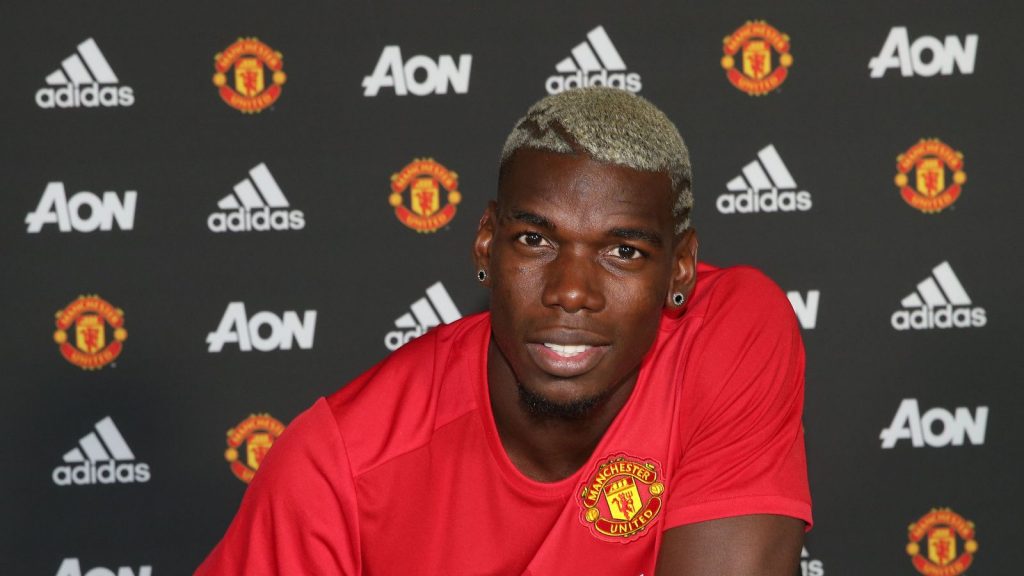
Being able to attract and fund world class players such as Paul Pogba, Sergio Aguero and Raheem Sterling points to the potential of the Premier League, and the first all English European final points to the coming reality: the Premier League is not only the most competitive league, but it’s also the most talented.

Pogba signs with Manchester United for a then world record fee of £89million. Source: Sky Sports

Could the reign of Spanish teams in Europe be coming to an end? Is this all English final a sign of things to come? For now we look forward to watching what will certainly be an exciting set of finals.

Are the NBA Playoffs still Fun Without Lebron James?

0

According to the Sports Business Journal, the NBA Playoff ratings were down 18% after the second weekend of games across TNT, ABC, ESPN and NBA TV. The obvious reason of course being the absence of Lebron James. But in a Playoffs filled with buzzer beaters, shock defeats and all the emotion, the Playoffs might still be just as much fun without the ‘King’.

With the absence of Lebron James, games are more competitive in the Eastern conference as James was always known as the dominant force, especially against the formerly known Lebronto Raptors.

As it pertains to the West its always been a survival of the fittest conference and certainly this year it’s even more true than normal with both OKC and the Denver Nuggets losing to the Blazers.

A star-less LA Clippers going to a game 6 with a full strength Warriors team whilst in the same vein a KD-less Warriors team managed to beat a full strength Houston Rockets team. All that to say, for the first time since 2010, we can expect to see an NBA Final without Lebron James.


Eastern Conference

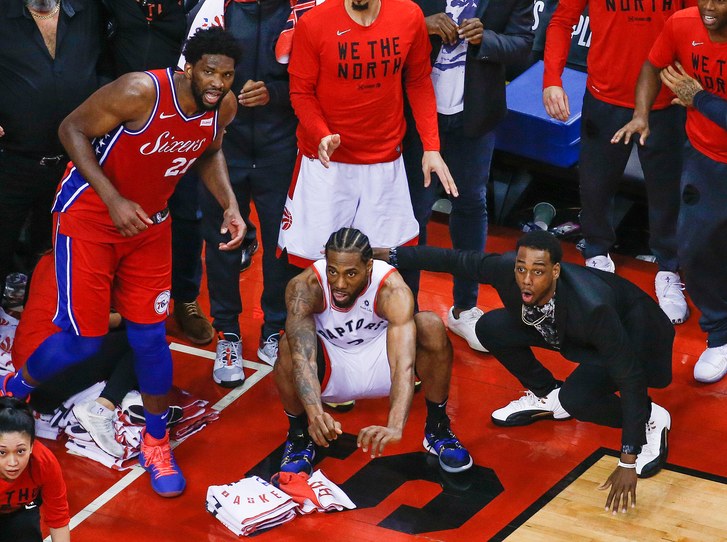
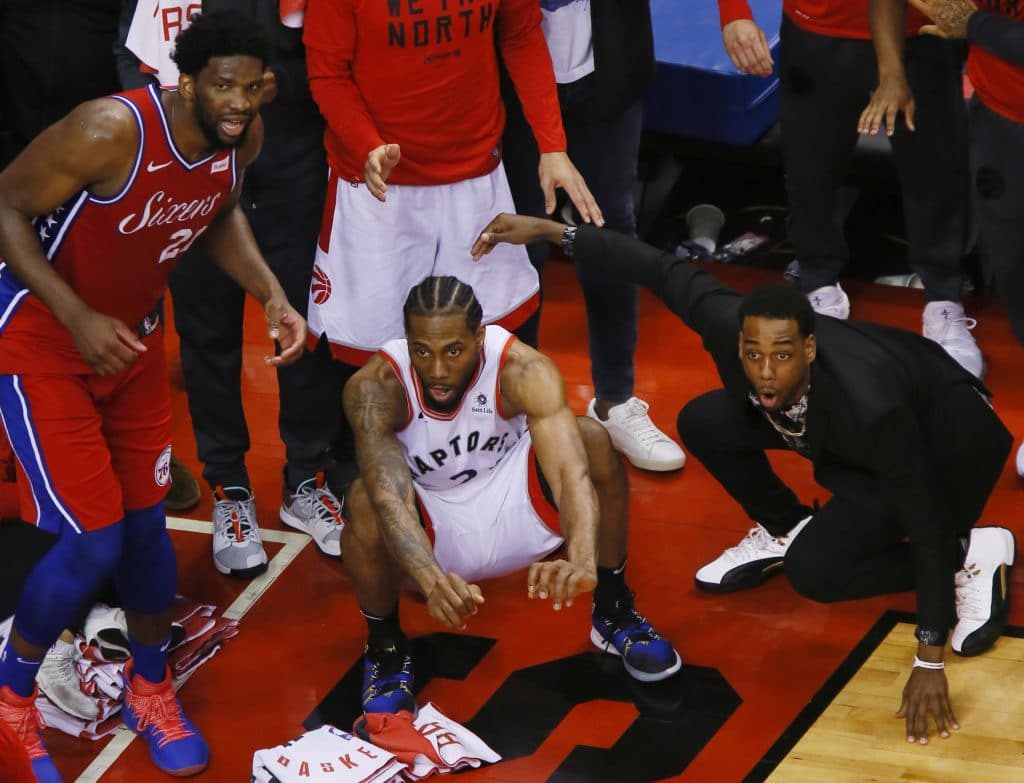
Kawhi and Joel Embiid watching in suspense as Leonards shot bounces into the net. Source: The Athletic


Milwaukee Bucks vs Toronto Raptors

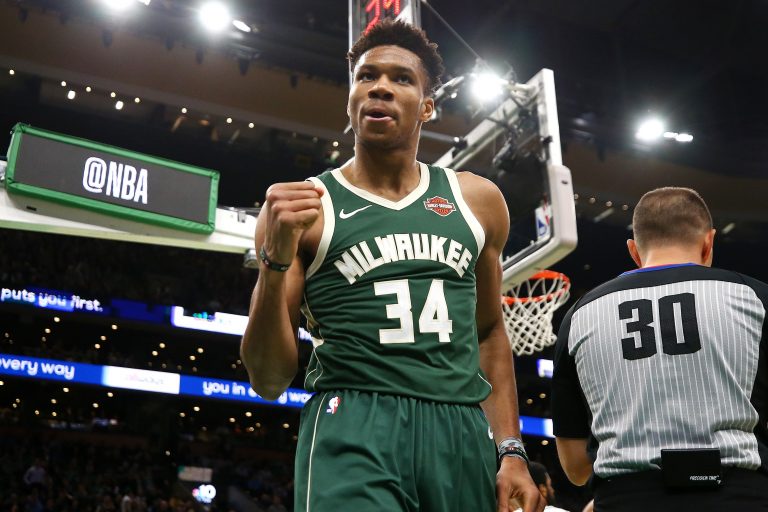
With both these teams being arguably the better teams in the east, we will finally get to see who is top dog when Giannis Atentetokumpo and Kawhi Leonard face off against each other.

The Bucks have had an easier second round compared to the Raptors. With the Bucks beating the Celtics 4-1 and the Raptors having to go to Game 7 at home, needing a walk off buzzer beater from Kawhi Leonard to clinch a spot in the conference finals. Leonard put the Raptors on his back and it was almost Jordan-esque how resilient and dominant he was in this series.

A rare occasion of Joel Embiid looking very emotional at the sight of his team having an early off-season. The Raptors fought hard and showed grit against the 76ers. The Bucks were able to quickly adjust after losing Game 1 with Boston Celtics legend Paul Pierce already proclaiming the series over.

Giannis was excellent averaging 28 points and 10 rebounds in the series and showed why he’s the MVP of the league against a talented team. Kyrie Irving had a disappointing series and game 5 was bitterly disappointing, only managing 15 points and 1 assists. It’s safe to say that he wont be staying in Boston come next regular season.


The Bucks who hold the best record in the NBA will certainly be ready to go up against the Raptors. With plenty of rest and time to evaluate what their game plan will be against Kawhi, it will give them a slight edge and possibly a win in the series. It’s almost certainly going to at least 6 games.

The Raptors are sure to feel confident in their hard fought battle against the 76ers. Additionally, the conference finals presents the perfect opportunity for under-performing players like Kyle Lowry and Serge Ibaka to redeem themselves after a poor series.


Western Conference

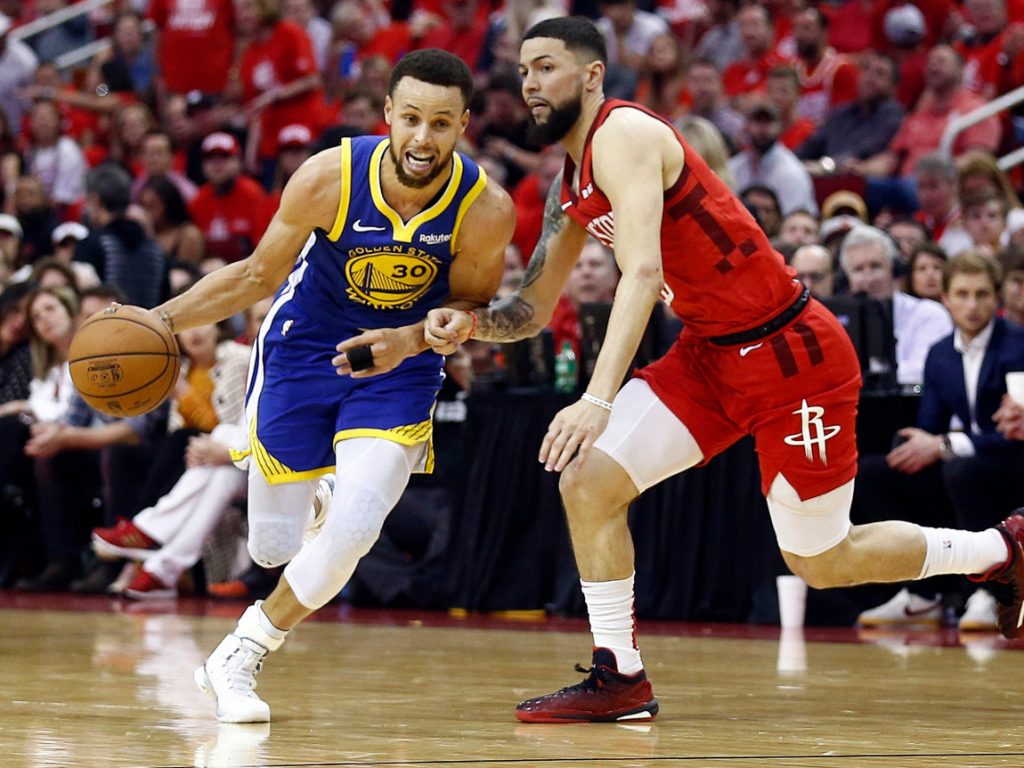
Stephen Curry driving past Austin Rivers in Game 6

https://53eig.ht/2Q0Picb

Golden State Warriors vs Portland Trailblazers

The Golden State Warriors managed to ward off the Houston Rockets in six games, winning 4-2 and having to play halfway through game 5 and all of Game 6 without their best scorer in Kevin Durant.

It seemed a tall order for them to clinch the series without going to a game, but Klay Thompson kept them in the first half as Steph Curry amassed 0 points, but erupted in the second half with 33 points and a whopping 23 in the 4th quarter.

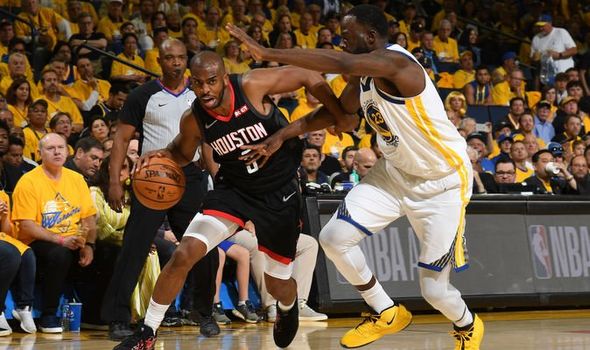
In the last 5 mins of the game, Curry scored the same amount of points as the whole Houston Rockets team which was 16. Chris Paul finally turned up scoring more than 20 points but it wasn’t enough, as we were all reminded that the Warriors were a champion team long before Durant arrived in the Bay.


The Portland Trailblazers became part of the 21% club of teams who have won a game 7 series away from home. With a monster performance from CJ McCollum who scored 37 points he was able to claw back the 15 point deficit to finally give the killer dagger in the 4th quarter.

Damian Lillard had a horrendous shooting night especially in the first two quarters. He couldn’t buy a shot and it seemed that he might follow suit in the same manner of Stephen Curry but in the end Lillard only managed 13 points, with 10 rebounds and 8 assists.

Two of the best back courts will face each other in the Splash Brothers Curry and Thompson to the Blazers McCollum and Lillard. They’ve faced each other plenty of times in recent years and unfortunately for the Trailblazers it’s not a pretty tale, with them losing every single time and even being swept in 2017 and losing 4-1 in 2016.

Frankly the Splash Brothers are better shooters than the Lillard and McCollum and individually Thompson and Curry have had bigger moments. This will also be a great opportunity to see the Curry brothers face off against each other which will be sure to produce a proud father moment in Wardell Stephen Curry, former NBA player for the Charlotte Hornets.

The Trailblazers will be the underdogs in this series and if they can stretch it to a 7 game series then they can prolong the inevitability of Kevin Durant returning from injury. The Warriors will feel they are matched up particularly well and will have to dig deep to their 73-9 days to play at their best.

Making predictions for these series are easy but as we’ve seen between the Rockets vs Warriors and Raptors vs 76ers, entertainment will be provided and twists and turns are awaiting all the teams in the Conference finals. No Lebron, no problem.

NBA Playoffs Second Round: The Best Bits So Far

0

The second round of the NBA Playoffs are halfway through in most of the match ups in the Eastern and Western Conference, each having played three games a piece. And it’s fair to say the Playoffs are really heating up.

Toronto Raptors vs Philadelphia 76ers

Joel Embiid puts in a dominating performance for Game 3 in Philadelphia. Source: CBS Sports

Kawhi and Embiid as the two best players in the series face each other head on with both possessing exceptional offensive and defensive capabilities that surpass the rest of the league.

However Kawhi Leonard has proven himself to be the more consistent player in the playoffs especially in Game 1 and 2 of this series. But Embiid’s Game 3 performance could not be matched. He put up 33 points, 10 rebounds and 3 assists in their 20 point blow out against the Raptors where the 76ers shot 51% from the field and 43% from the three point line.

In fact the 76ers had a better shot percentage from the three than the Raptors did for field goal percentage at 42%. Their teams are both loaded, whoever’s wins this series is most likely favourites to go to the finals. So far Lowry and Simmons haven’t put on a spectacle in this series but Siakem (who’s likely the most improved player in the league) and Jimmy Butler certainly have. With the 76ers winning Game 2 they’ve managed to steal home court advantage away from the Raptors. The tides have turned against the Canadian team as they were pitted to win this series.

My prediction for this series is a Philadelphia 76ers win due to their starting 5 collectively is better than the Raptors and frankly right now the Raptors bench isn’t aiding the team effectively enough.

Golden State Warriors vs Houston Rockets

Warriors vs Rockets at the Oracle Arena. Source: CBS Sports

The most anticipated match up of the whole NBA playoffs and its come a round quicker than last year due to the Rockets’ seeding position.

A star studded Warriors team against a Houston team with MVP Harden and Chris Paul who nearly knocked them off their throne last year when the series went to seven games.

Kevin Durant has been sensational so far in the series putting up 35 points in Game 1 and 29 points in Game 2. He’s proving why he’s the best player in the world and along with a healthy Andre Igoudola is making the difference in the series for The Warriors.

With Steph Curry and Klay Thompson both suffering from ankle injuries and Curry furthermore suffering from a dislocated finger it will be an interesting series as to how Houston can exploit this in physicality and being clever in their plays.

In Game 2 Harden suffered an eye injury which he used as an excuse for his performance even though he put up 29 points. His team however, needed more offensive rebounds and needed to lower the amount of turnovers which was a deciding factor for they’re loss in Game 2. In Game 3, the Warriors suffered their first defeat losing 126-121 after the game went to OT.

James Harden scored a whopping 41 points and Kevin Durant answered right back with 46 points, with 17 in the third quarter alone, however it wasn’t enough as Curry missed a wide open dunk in OT that allowed the Rockets to seal the deal. The Rockets deserved this victory as Golden states Curry and Thompson have been a shadow of themselves again and need to regroup.

My prediction is that the Warriors win this series in 6. Even though both teams haven’t played at their best with the Rockets already losing 2 games might prove to be too difficult for them to pull back against the 2x defending Champions.

https://deadspin.com/the-four-overtime-slog-between-the-nuggets-and-trail-bl-1834524931

Portland Trailblazers vs Denver Nuggets

CJ McCollum celebrating the Blazers 4x OT victory in Game 3. Source: Dead Spin

The Blazers were favourably ranked to beat the Nuggets after their amazing win against OKC even though the Nuggets are the second seed and so far the Blazers are holding true to that.
For Game 2 CJ McCollum came to the Blazers rescue and carrying them to tie the series with 20 points, 6 rebounds and 6 assists being the only player on the floor to even reach 20 points. And once again in Game 3 CJ McCollum came up big again in a 4x Overtime thriller with victory against with 41 points. The last time a game went to a 4x OT was back in 1953 and certainly neither team was prepared for such a marathon of a game but for the neutral it was phenomenal.

My prediction for this series is a Blazers win, this particular series however is the most difficult to call. It all depends on if the Nuggets can still shine through their lack of playoff experience.

BREXIT: What Does The Future Hold For English Football?

by Hal Fish

Since the formation of the Premier League in 1992, English football’s top division has developed into a vast melting-pot of diversity and culture. In fact, just 12 of the competition’s possible 31 Golden Boot winners have been English. Fascinatingly, in the first nine seasons of the competition these league top scorers were all English, but since 1999 only three winners have been from Britain – a stat which clearly outlines the multicultural nature of the league. And whilst England may have a strong claim for having the most entertaining competition in the footballing world, this assertion comes with a great debt owed to the foreign talent within the country.

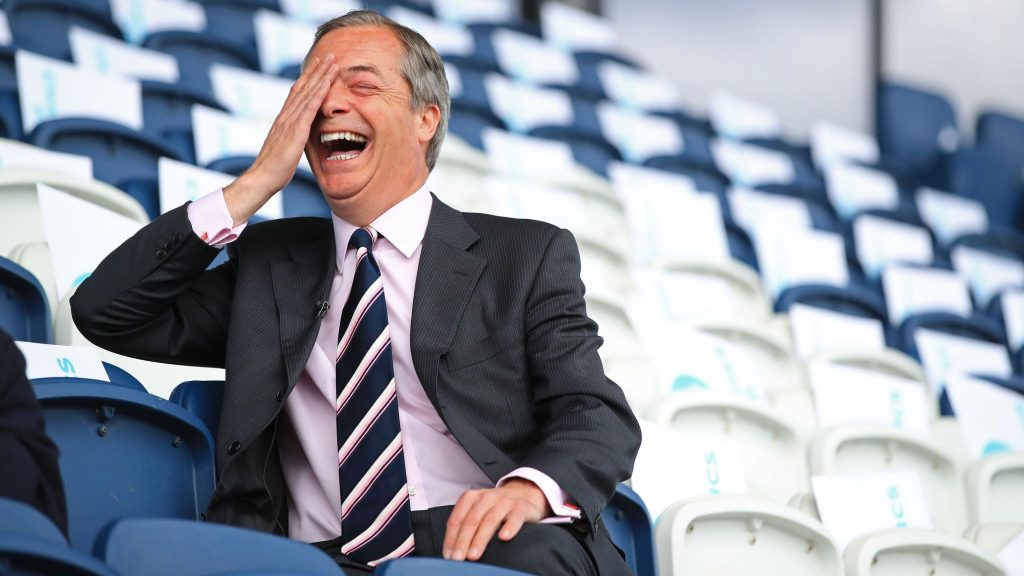
Nigel Farage (source: Sky News)

Sadly, however, despite the countless range of different ethnicities on the field providing fans with top quality entertainment, issues of racism and discrimination have always cast a murky shadow over the English game; much like in the rest of the world. Recently it has felt as if we are never too far away from a small but notable section of any club’s fanbase disgracing themselves with acts of abhorrent racial and xenophobic abuse targeted at the footballers; who, after all, are just people in their place of work.

A recent high-profile example of this occurred in April 2019 when Chelsea fans – travelling to the Czech Republic for their Europa League tie with Slavia Prague – began chanting ‘Salah is a bomber’ in reference to the ex-Chelsea and current Liverpool winger Mo Salah: a Muslim from Egypt. The Guardian reported that three of the Chelsea fans were immediately identified and banned from entering the Slavia Prague stadium and will face further action from the club at a later stage. But as of yet that action, if any, has not been made clear to the public. 

In satisfactory fashion, just three days later, Salah responded to his abusers on the field by scoring a wonderful goal in Liverpool’s 2-0 league victory over Chelsea. He pulled a one-legged yoga pose in his celebration, his hands pressed together, perhaps alluding to a message of calmness and peace. However, it shouldn’t have to be up to the players to respond on the field; more action must be taken off the field by the governing bodies such as the FA, UEFA, and FIFA as well as the clubs involved. 

Indeed, one of the biggest off-field areas of debate at the moment is just how to correctly issue punishments when disturbing racist events, such as the Salah incident, occur within the context of the game. Raheem Sterling, a Jamaican born England international, who plays for Manchester City, stated in an article he wrote for The Times that he “would call for an automatic nine-point deduction for racist abuse. It sounds harsh, but which fan will risk racist behaviour if it might relegate their team or ruin their title bid.” Such a rule change would certainly send out a clear message to all that such ill actions will no longer be tolerated. 

The irony of it all can be a hard pill to swallow at the best of times. Quite frankly the Premier League relies on black, Asian and minority ethnic (BAME) migrant talent to maintain the quality of football within the league. In return, the league ought to do its best to provide a safe environment for those players to work in. But if it continues to fail in doing this, perhaps footballers will start to look elsewhere. The league’s appeal certainly must be fading for migrant players; and this issue may well be further exacerbated by the impact of Brexit. 

The UK has previously been quite accessible for young emerging talent. Although FIFA bars all players under 18 from moving to a foreign club, they make an exception where those aged 16 and 17 can move across teams and countries within the European Economic Area. Former Arsenal and Chelsea midfielder Cesc Fabregas is a notable example of this. In 2003, as a 16-year-old, he left FC Barcelona to join Arsenal – taking full advantage of the free movement between Spain and England. His move brought him near immediate success: still aged 16, he became the club’s youngest ever senior player and goal-scorer.

However, if a player wanted to follow a similar path post-Brexit, they will come across many more obstacles. Brexit not only brings the end of transferring under 18s across the Continent but also means European players who want to sign for British clubs will have to apply for a Tier 2 Sports Visa. This Visa requires the FA to endorse the application and the player must be considered an ‘elite’ sportsperson as recognised by the governing body. This process could take up to three weeks which may be problematic when teams look to make last minute transfer deals. Also, the Visa only covers a stay of three years; though this can be extended to six. 

Whilst this won’t necessarily prevent the best and highest paid players from coming over, it will likely affect those who fall into a lesser bracket of footballing quality and stardom.  The lower leagues, and even the smaller Premier League teams, may suffer significantly as European players will likely prefer to avoid the hassle of visa applications when they could just move to another club in the EU without so many complications.

For well over two decades now, the best players from across the globe have flocked to England with ambitions of playing in football’s most competitive league. But as Britain breaks off from the EU and free movement comes to an end this may no longer be the case. Premier League clubs will likely miss out on the previously accessible emerging talent, who will now be snapped up by the European clubs still able to sign those youngsters. And, on top of this, the break with the EU after Brexit, alongside the disturbing rise of racism, will make Britain a less attractive prospect for senior professionals.

Those factors working in tandem could quite significantly change the face of English football across the next few seasons. As a result, the Premier League could regress from one of the most exciting and diverse leagues in the world, into something much more culturally bland and sportingly uninspiring. 

Hal Fish is a specialist content writer and correspondent for the Immigration Advice Service – the UK’s leading organisation of immigration solicitors

#NORTH30: Northern 30 Under 30 List Revealed

Read the full list here: #NORTH30

Rifts between The North and The South are not new. London has swallowed most of the energy, resources and money to help it reach its global city status that dominates narratives about the UK. For some time now, research has been conducted on how wealth has been distributed between London and the rest of England. One study even showed that there was a £700 difference per head that was being spent in London compared to Birmingham on transport alone (£300 per head being spent on transport in Birmingham compared with £1000).

In fact, a third of ALL arts funding (research by Rebalancing our Cultural Capital) gets spent in London! In 2018 London received about £24 per person, compared to £8 elsewhere, (or just £3 per head for Cheshire and Warrington).

As companies move further and further up North, dramatic transformations are being made to the infrastructure that mans that the North is becoming more and more attractive to businesses, influencers and moguls across the board. Businesses moving up North for greener pastures are causing a snowball effect – it attracts more investment.

In fact, some research suggests the investment in the northern tech industry is growing faster than anywhere else in Europe, at a rate of 619 percent (between 2012 and 2017).

There are many young people (under 30) that have been part of this shift, that have created new infrastructure and made significant developments across industries within the North of England.

Now is the time for change

From footballers to social entrepreneur, to financial moguls and creatives, The North of England is home to some of the most successful ‘up and coming’ millennials making an impact and trailblazing in a number of industries; yet attention is often focused on London.

With, #NORTH30, we are changing that. The Common Sense Network’s list of 30 trailblazers under 30 challenges the perception that success for young people only comes from moving to the capital.
#NORTH30 celebrates the achievements of outliers under the age of 30 who are changing the game in the North of England.

The belief that there is a lack of opportunity for economic development outside of London is false.

The Common Sense Network invites you to nominate your favourite trailblazers for the #NORTH30. To qualify, the person must be from or based (living and/or working) in the North of England (i.e. Humberside, North East, North West and Yorkshire) and must be under 30 years of age (as of 30th September 2019).

CLICK HERE TO DOWNLOAD FULL LIST

Did Harry Kane really Deserve an MBE?

0

As the Premier League draws to a close, it seems Tottenham will again walk away with no silverware unless they can advance to the Champions League Final and do the unthinkable. Off the pitch however, Tottenham talisman, Harry Kane, picked up silverware of his own, much to the collective eyebrow raise of the nation.

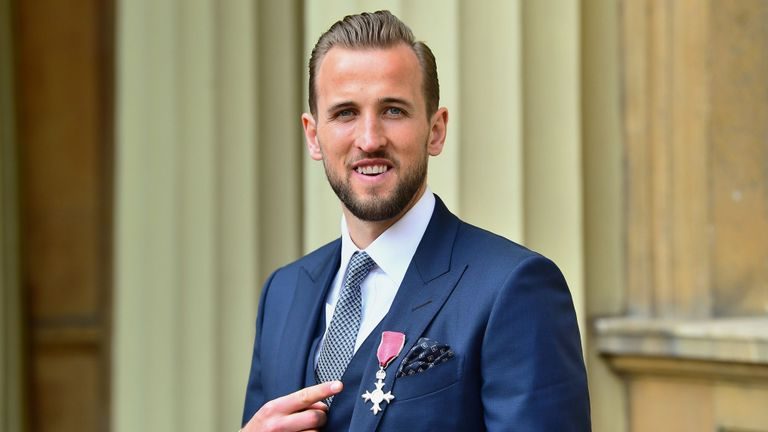
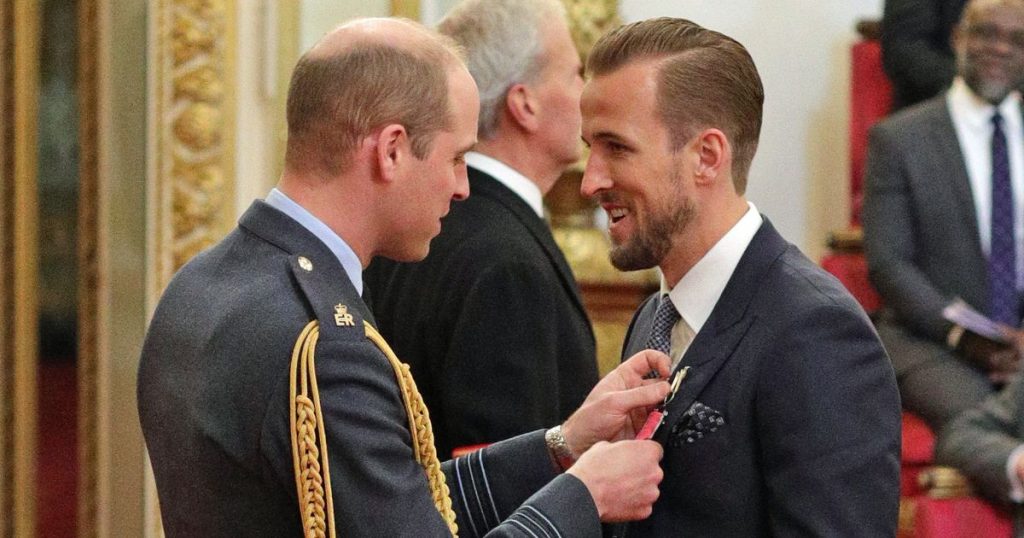
The Member of the British Empire (MBE) is a British order of chivalry, rewarding contributions to the arts and sciences, work with charitable and welfare organisations, and public service outside the civil service. In March this year Harry Kane was awarded an MBE for services to football after winning the golden boot at the World Cup.

Harry Kane receives his MBE from Prince William. Source: Daily Mirror

Kane scored six goals (including two penalties) in Russia, notching a hat-trick against Panama, two against Tunisia, and one in the last-16 victory over Colombia as Gareth Southgate’s men reached the semi-finals. However, one can’t help feeling as though Kane has been indulged for doing exactly what is expected of him.

Kane received his award alongside Hearst Magazines (Cosmopolitan, Marie Claire) Chief Content Officer, Joanna Coles and MasterChef winner and restaurateur, Thomasina Miers, with both making significant contributions to journalism & the food industry respectively. These awards should be reserved for substantial contributions, whilst the contributions of these recipients aren’t exactly comparable, the informed reader could reasonably conclude that Kane’s contributions are dwarfed here.

Joanna Coles with her OBE for services to journalism and to the media industry. Source: AOL

A few days after Kane’s award, Gareth Southgate received his OBE award for services to football after he led the national team to the semi-finals of the FIFA World Cup for the first time in 28 years. Southgate’s conduct throughout the tournament was inspiring, not only for his players but for the nation as a whole. At a time when consensus was hard to come by – you know Brexit – you’d be hard pressed to find someone who didn’t support Gareth Southgate as England manager.

Lady Luck smiled on England last summer handing the Three Lions a favourable path to the semi-finals, with Colombia, Croatia & Belgium being the most challenging opponents in their tournament run. In four matches against these opponents, England managed 3 losses and a draw, beating Colombia on penalties, with Kane only scoring once.

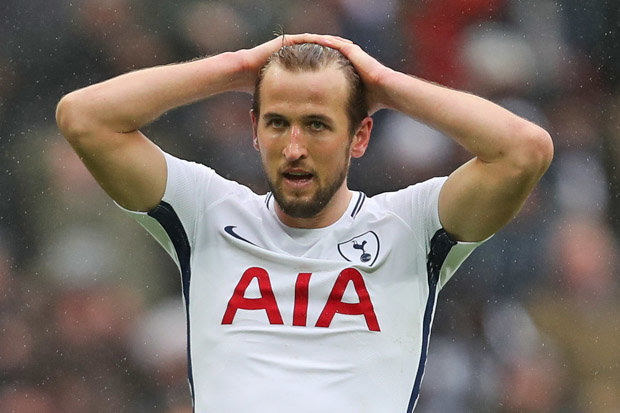
At age 25, the fact remains Harry Kane for club & country has won nothing is disappointing; a league cup runner-up medal is all that hangs from what would be a bleak looking mantelpiece.

Harry Kane is yet to lift silverware with Tottenaham. Source: Daily Star

In contrast, fellow countryman and newly crowned PFA Young Player of the Year, Raheem Sterling, is on the verge of retaining the Premier League & potentially winning the FA Cup, completing a full sweep of English trophies this season.

No doubt Tottenham Kane fans will be quick to boast about the list of personal honours Harry Kane has: PFA Young player of the year, 2x Premier League Golden Boot and 2x England Player of the Year amongst others and they’d be right to do so. But the reality is this MBE is for services to football. Last summer England won nothing & Kane scored a load of goals against part-timers who were merely happy to be there. Whilst he may eventually deserve an MBE, at the very least this award is premature, Harry Kane does not deserve to be a Member of the British Empire.

The Fallout Continues Over National Security Council Leak

The fallout has continued following the National Security Council leak of the decision to allow Huawei to participate in the UKs 5G infrastructure.

The Cabinet Secretary, Mark Sedwill, has reportedly launched a formal inquiry into which one of the cabinet ministers leaked the controversial decision. The inquiry reportedly began on Friday, as ministers and their aides were requested to fill in questionnaires regarding the leak. The questionnaire is said to request information about where the ministers were and what they were doing the hours following the meeting.

They were also asked about what methods of communication they used and whether they had been in contact with the telegraph newspaper, who broke the news.

All of the ministers have purportedly given consent for the Cabinet Secretary and his team to examine the record of their calls and messages.

There is some concern that the leak will damage the confidence that the UKs intelligence partners have in the UK. The UK has historically had a very robust intelligence regime, being part of the ‘Five Eyes’ intelligence alliance with the United States, Canada, New Zealand and Australia.

According to Gus O’Donnell, the previous Cabinet Secretary, ministers face having their phone records reviewed as part of the investigation.

Jeremy Hunt, Foreign Secretary, who is also under investigation due to the leak, has been vocal in his opposition to Huawei having a role in the 5G infrastructure in the UK.

What is the National Security Council?

The National Security Council sets forth the national security strategy for the United Kingdom. It is chaired by the Prime Minister and is comprised of senior ministers. These are usually the Cabinet Minister, the Chancellor of the Exchequer, the Home Secretary, the Foreign Secretary, the Defence Secretary, the Business and Energy Secretary, the International Development Secretary and the Attorney General.

Why is there so much adversity against Huawei?

There is concern that as Huawei is headquartered in China, they can be compelled to cooperate with Chinese intelligence agencies.

In 2017, China enacted a law that can compel any Chinese company to assist with intelligence operations. The western world is worried that China intend to use Huawei to spy and interfere with western countries.

The United States has already banned Huawei from participating in their 5G infrastructure and are actively putting pressure on their allies to follow suit.

Stocks On Steroids

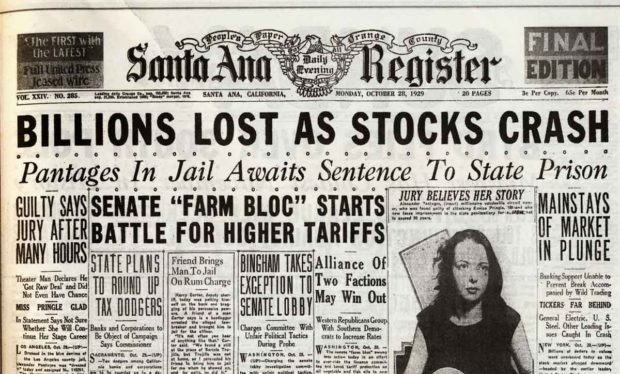
Galbraith’s seminal work “The Great Crash 1929” is prescient for investors braving the market turmoil in 2019 not only because of its articulate presentation of complex economic interactions – a rarity by any stretch – but also the parallels between then and now.

He believed people needed constant nudges to temper poor choices in what he termed a “mass escape from reality”. Or else, we’d all fall into the same honeypot without learning any lessons.

Instead of passing the buck to government regulators, Galbraith saw memory a better check and balance to insanity than any law.

Individuals buy into the illusion that good times will keep on rolling

A perverse cognitive bias lulls them into a false sense of security. After all, normalcy dictated that no disaster happened, despite the doomsayers – they’re just bitter they didn’t return 50 per cent on tech stocks this last year. Clearly, they want to spoil our fun with a sell off so they can enter at more reasonable valuations. If no disaster happened then, it never will. This line of inductive reasoning can make coping with catastrophe hard. Normalcy bias breaking down before one’s eyes can lead to inability to process and react accordingly. Notably, people tend to interpret warnings in the most optimistic way possible, seizing any ambiguity to infer a less serious situation.

Each time the market has matched or exceeded current valuation multiples it was followed by a crash of between 40% and 80% over a few years. It’s clearly inadvisable to buy today. Credit: Oftwealth

There is no justification for induction without using induction in the first place. In other words, any argument for induction would be based on the fallacy of begging the question. So then, we could say that induction is the fallacy that has taken place in his reasoning.

Of course then, rising markets are the natural state of nature. And, falling markets are manipulation.

Galbraith doesn’t lay the blame for the Roaring 20’s reckless disregard for temperance with politicians to check in with stockbrokers. Instead, it was the inevitable product of individuals in their thousands making poor choices. A result of aggregated free will of the masses marred by illusions of get rich quick with minimal effort in a booming economy of low unemployment, rising wages and corporate earnings leading to ignoring the immense risks involved.

Florida’s mid-20’s real estate boom was fuelled by low-margin, down-payments, some as low as 10 per cent. Wind forward to the early 2000’s and the advent of No-Income-No-Job-No Assets (NINJA) loans led to the modern day equivalent real estate bubble. It was only a matter of time before the train derailed.

The hurricane season of 1926 showed these inductive fallacies proved false. Two struck Florida, destroying homes by the thousand and wiping out the speculator market overnight.

Amid such devastation, such was the optimism bias, the public were convinced beyond rhyme or reason “God intended the American middle class to be rich”.

1927, and the Federal Reserve fuels the flames

A stock market at unjustifiably high multiples of earnings, adjusted or otherwise. Expansionary monetary policy by the Fed cut interest rates and bought swathes of US Treasury bonds.

Excess liquidity found its way into the stock market, typically via credit loans to purchase stocks on margin.

Galbraith described this mania as a “mass escape into make-believe started in earnest”. The industrial corporations began drawing on their cash reserves to play the markets, and when those surpluses ran short, they simply issued new shares to continue their foray into stocks. All of this came at the opportunity cost of not investing in new production. Walter Bagehot noted that “people are most credulous when they are most happy”. The delirium of gains fed mass hysteria, leading to a speculative bubble. As with all bubbles, they are fragile by their nature. It was only a matter of time.

By September 1929, buyers were simply no longer convinced they could sell on for a profit. The volume of buyers dried up and momentum with it. Brokers called in margin payments and speculators were forced to sell to repay their loans. Confidence dissipated, with panic finally setting in October as “blind, reckless fear” drove the market to mad scrambles to sell.

It is a feature of the capitalist economic system that periods of economic growth end in speculative booms that proceed to confidence evaporating, fleeing the assets that cheap money and margin lending skyrocketed in its build up.

Galbraith pleaded with his readers to take stock – literally and metaphorically – where rising prices beget higher prices, without any bearing to the underlying fundamentals to justify such prices. One only need cast their memory back to some past instance where illusion replaced reality, and everybody got screwed. The crypto bubble in early 2018 is one such instance of grand mania blinding everybody to the reality of what they were involved with. More recently, the fourth quarter equities sell-off led to irrationally timed selling out at the base of the market and buying back in at the top when sentiment rallied.

Timing the market is notoriously difficult. It is generally time in the market as the variable that determines long-term returns. This metric and pound-cost averaging your purchases to smooth out the troughs and peaks.

Few can do a superior job of predicting macro-future trends of economies, markets, currencies and interest rates. Smaller arbitrage is possible with deep-level research into micro industries, companies and securities the market hasn’t appropriately valued because of sentiment and the allure of story stocks and safe havens.

What Galbraith was urging on the side of caution towards was paying attention to the two variables that will determine future security prices given long enough: fundamentals and valuation. You can boil fundamentals down to what the company will earn in future. Earnings are what stock markets really consider, and most other aspects can be reviewed in relation to influencing earnings. Earnings per share (EPS = total earnings/number of shares) is the most reliable determinant of stock valuations.

The trouble with current valuations in America is they are out of kilter with long-term trends. This would be fine if the companies were generating high income streams to justify their expenditures, of note, technology stocks. And some analysts have said you can’t gauge these new stocks and emerging technologies against old school financial metrics like EPS. History has showed this to be a flawed sentiment thus far.

Valuation” is the consensus between investors of current and expected future fundamentals. Stocks tend to use price to company’s earnings per share (P/E Ratio). Multiplying future EPS estimate by projected P/E Ratio gives the projected future price.

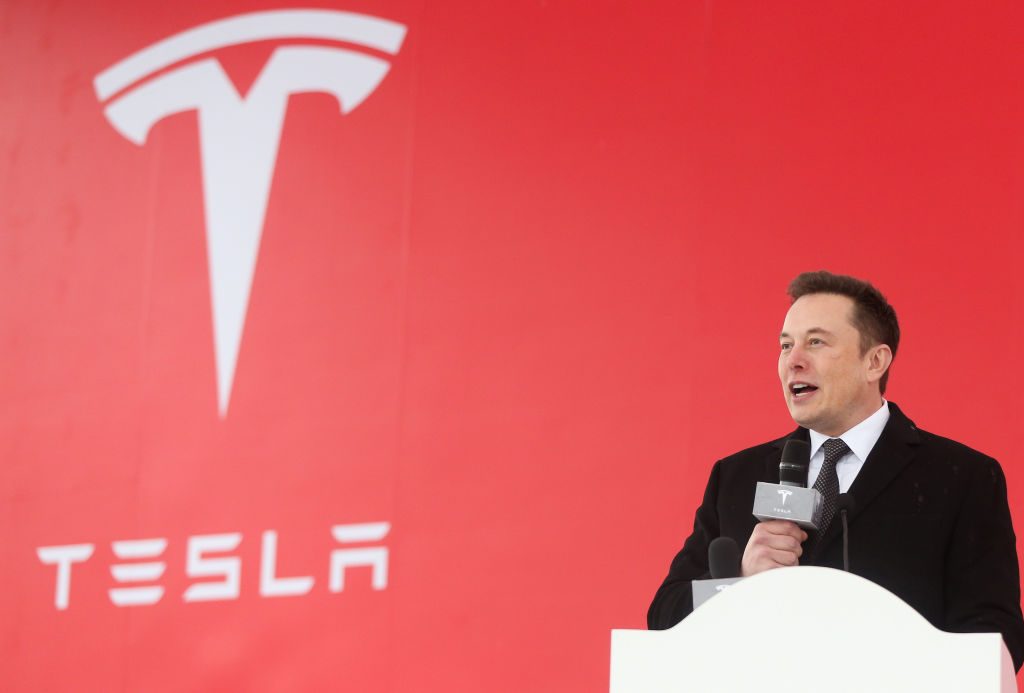
For any given level of EPS, a variety of P/E Ratios may be assigned by investors, and a variety of stock price outcomes can materialise. All else being equal, higher investors’ opinion of a company, the higher the P/E Ratio assigned by the market to its stock. This is likely to produce positive surprises and its earnings growth can be depended on. Product sex appeal, the stock’s founders and story and its management figureheads feature prominently in these valuations. Think Apple’s Steve Jobs or Tesla’s Elon Musk.

Story Stock Tesla & CEO Elon Musk (Xinhua/ via Getty Images)

To ignore valuations is at your own peril as an investor

In other words, the price of a company’s stock will be a function of what it does (earnings) and how investors react to what it does (valuation). Valuation will be determined by numerical norms and psychological adjustments. And all of the above will be influenced by the macro environment – what’s going on in the world and how investors feel about that. It’s hard to know all the above, and hard to know it better than others. That’s why I’m guarded about the relevance of “how can you predict?”
If Galbraith were around today, he would probably be advocating caution on the fundamentals/valuation side with the American stock market at precipitous highs after a decade bull run, unemployment back down at 3.9 per cent, and weakening corporate earnings outlooks. Especially considering the rest of world is on par or undervalued against their long-term returns, and large players like Chinese stocks are still reeling from the Trump trade war fallout and European markets with the Brexit conundrum. Having said this, ignoring the American market generally comes at the disappointment of missed returns. So perhaps, a rebalancing of portfolios with some dollar and/or gold hedging to re-enter stocks after the next correction and larger positions in low P/E Ratio, yet growing marketplaces.

2018-19 NCAA Men’s Basketball Winners and Losers

0

Duke freshman Zion Williamson, the consensus player of the year, officially declared his eligibility for the NBA draft. Williamson ranked by many as the No.1 prospect made his announcement on Instagram, saying playing for Duke had been the “best year” of his life.

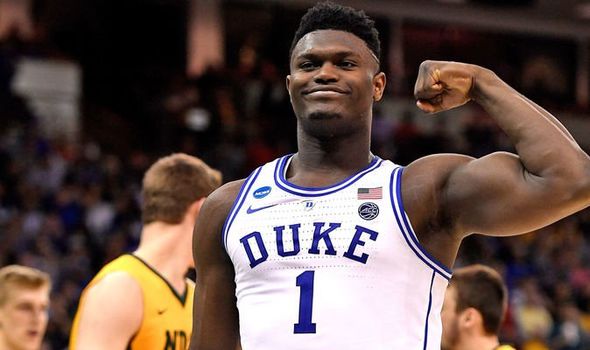
6-foot-7, 285-pound Williamson became the face of college basketball with his freakish, once-in-a-generation athleticism; his energy at both ends of the floor, routinely coming up with at least one highlight-reel play or show-stopping dunk per game.

Zion William: This year’s top NBA prospect. Source: Express

On May 14th, the NBA will hold its lottery to determine which team will draft Zion. New York, Phoenix and Cleveland hold the best odds, followed by Chicago and Atlanta, however the rest of the draft remains uncertain with March Madness producing winners and losers likely to dictate NBA front office decisions on May 14th.

Ja Morant, Murray State Racers (Winner)

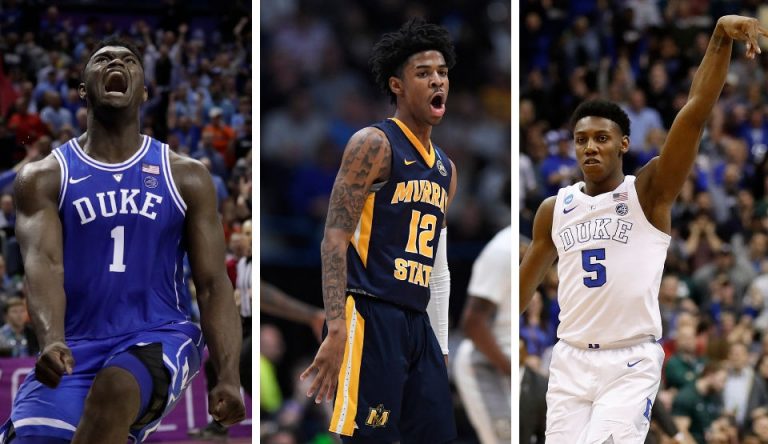
Not many players were better than Ja Morant this year. Zion Williamson was, and a case could be made for RJ Barrett. That’s it. Murray State’s lead man put up 24.5 points, 10.0 assists, 5.7 rebounds and 1.8 steals forcing his way into the top-three in most mock draft boards.

Morant’s performances blindsided most because unless you live in Kentucky or shell out $5 per month for an ESPN+ subscription, you barely got to see Morant. Prior to March, the Racers only played four nationally televised games. Fans had likely heard of Morant with a handful of his athletic highlight plays doing the rounds on social media, but the NCAA tournament was probably the first time a lot of people would have watched the majority of a Murray State game.

Ja Morant has unexpectedly caught NCAA headlines this year. Source: Sports Illustrated

To put it bluntly, the boy has game.

Earlier in the season against Auburn (final four participants), Morant put up 25 points, seven assists, eight rebounds and against Alabama 38 points, five assists and nine rebounds.

In the blowout loss to Florida State in the second round, Morant was impressive and finished with 28 points. He’s held his own against elite NCAA competition. As a runner up in the Zion raffle, Morant is more than a worthy consolation prize.

Projection: Top 3 pick

NBA comparison: DeAaron Fox (With a better jump shot).

Carsen Edwards, Purdue Boilmakers (Winner)

Ja Morant aside, Carsen Edwards is quite probably the biggest winner in the 2018 – 2019 season and probably the biggest winner as a result of the NCAA tournament.

Coming into his sophomore year, Edwards was the only notable name on the roster and the Boilmakers were very much an Edwards or bust team. Fast forward to the end of the season and that prediction holds true, Edwards took 37.5% of Purdue’s shots while he was on the floor.

Edwards was a key player for Purdue this season. Source: Journal and Courier

Edward’s ability to convert those shots during the tournament have seen his draft stock sky rocket. He was not considered a first round pick before the start of the season, however after shooting 45.9% from three-point range and averaging 34.8 points in the tournament, the general consensus has changed.

In four games, Edwards had 139 points almost finishing with more points than Kemba Walker (141 points) did in six games in 2011. He did finish well ahead of what Stephen Curry (128 points) produced while leading Davidson to the 2008 Elite Eight.

Projection: Late first round

NBA comparison:  Patty Mills (with a little less playmaking)

Cam Reddish, Duke Blue Devils (Loser)

Cameron Reddish is one of the more overall talented players in this year’s draft, but he’s yet to fully capitalize on all of his gifts up to this point in his career. He has games where he looks like a star player followed by 1/11 field goal shooting performances. Reddish still has some development/maturing to do on a mental level as his confidence comes and goes. It appears to be the Achilles heel that’s holding him back from being all he can as a prospect.

Reddish in theory is someone who can shoot, defend, play-make in P/R, finish over the top, etc. All of which he does in flashes, but you’d like to see more consistency from him on a nightly basis.

With that said, he has shown that he can compliment other star level talents as he’s done a nice job being the talented 3rd option alongside Zion Williamson and RJ Barrett at Duke. Reddish may prove to be a late bloomer who rounds into his game after a few developmental seasons in the league. His team situation, much like many other one and done prospects, will be critical for his long-term outcome.

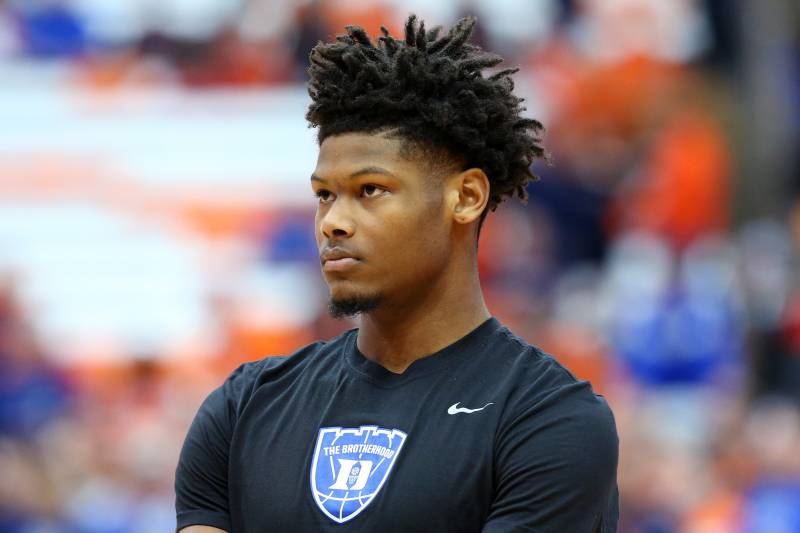
Reddish has seen his draft stock drop this season. Source: Bleacher Report

He’s in the fragile stages of his game where he’s still figuring out how much talent he has and how to maximize it. A stable organization who won’t demand too much from him too soon and could surround him with attention/veteran players would do him well. Overall, Reddish is a lottery pick based on his physical tools and the immense talent he teases us with. While he has star potential he’s more likely a starter/rotation player in the NBA.

Projection: Lottery

NBA comparison: Rodney Hood (Yes, just as streaky)

Rui Hachimura, Gonzaga Bulldogs (Loser)

Hachimura made obvious improvement from his sophomore to junior year. The 6-foot-8, 235-pound forward is a consistent scorer with a strong mid-range game and good ability to get to the foul line. Hachimura hit 41.7% of his 36 three point attempts this season after making just 22.5% in his first two seasons.

He also proved able to get up and down the court better than opposing big men, allowing the Bulldogs to run a high-octane offense that sat in the top 20th percentile in pace while ranking No. 1 in points scored per 100 possessions, according to Basketball Reference. A potent mix.

However, despite his improvements, he was rather disappointing in the NCAA tournament. At times during Gonzaga’s tournament run, Hachimura looked raw, lacking a natural feel for the game when a play broke down or the shot clock was expiring which hindered Gonzaga when up against higher calibre opponents.

Projection: Lottery/ Late first round

NBA comparison: Antwon Jamison (Who? Yes, that’s the point)

The Common Sense Network Mock draft lottery

  1. Zion Williamson, PF, Duke
  2. Ja Morant, PG, Murray State
  3. RJ Barrett, SG, Duke
  4. De’Andre Hunter, SF, Virginia
  5. Jarrett Culver, SG, Texas Tech
  6. Coby White, PG/SG, North Carolina
  7. Jaxson Hayes, C, Texas
  8. Sekou Doumbouya, PF/SF, Limoges CSP (France)
  9. Darius Garland, PG, Vanderbilt
  10. Cam Reddish, SF, Duke
  11. Brandon Clarke, PF, Gonzaga
  12. Romeo Langford, SG, Indiana
  13. Nassir Little, SF, North Carolina
  14. Bol Bol, C, Oregon
  15. PJ Washington, PF, Kentucky

We Need To Talk About Collusion, Or The Lack There Of

by CheVaughn Starling 

Unless you have been living under a rock or worldwide news doesn’t interest you, you pretty much know about the cluster of nonsense in America that is the Special Counsel Investigation or what I like to call: “The Truth on Whether or Not Vladimir Putin is Really Our President” Investigation. For the past two years, Americans (and other nations) have been waiting patiently, crying impatiently, or laughing hysterically on whether the President of the United States colluded with Russia in the 2016 election. 

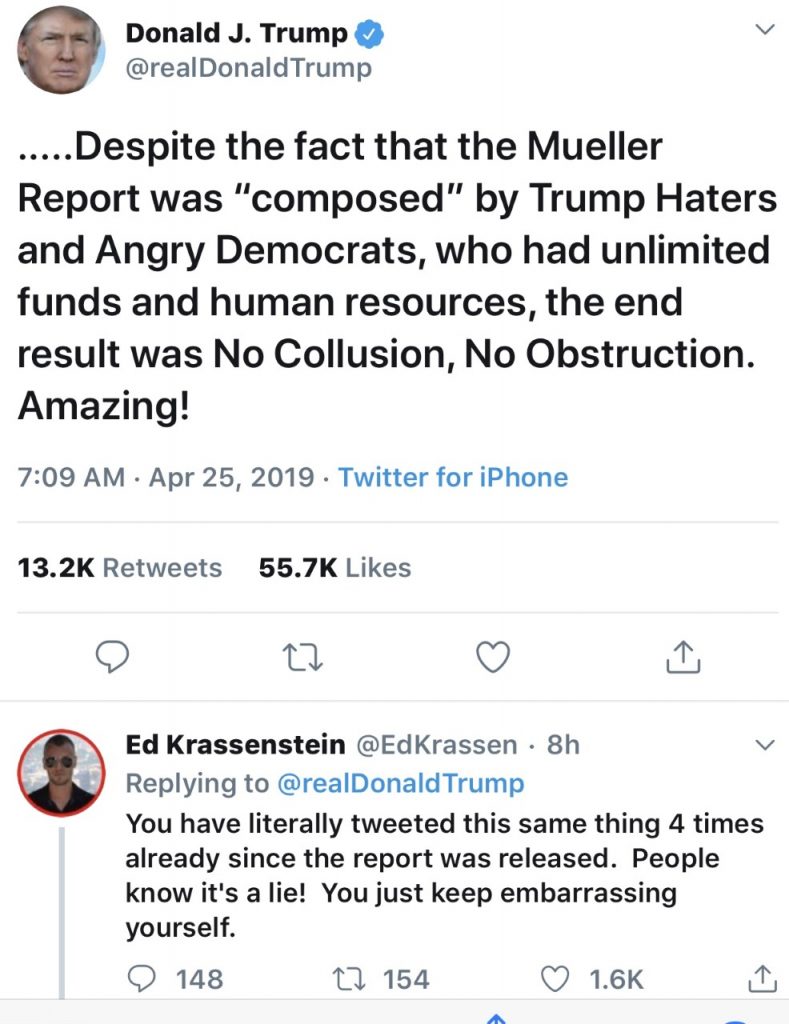
If you are a ‘tree hugging liberal’, you’ll be highly disappointed with the fact that this man did not. If you’re a ‘snooty conservative’, you’ll be thrilled that he did not collude. If you are indifferent, this whole article might not apply to you and you could very well go back to living your best life! However, if you are a Trump supporter and a part of the “MAGA” (Make America Great Again) Hive, then you’ll be one of the annoying people that have not shut up about this damn investigation since it started. YES, WE GET IT! Your favorite president did not collude with Russia. You were right, the rest of us was wrong! Okay, let’s move on!

Nevertheless, there are a lot of people on both sides that are having a very difficult time letting go and moving forward. It’s almost like a bitter ex that will just not leave well enough alone and move on with their lives. I’m sorry Sharron, Tim has moved on and is happy. Can you like worry about healthcare, please? Oh no? We are not going to do that? Ugh, Fine! It might be beneficial to give a little background on this whole investigation and explain why people, especially the Democrats, are a little upset.  

Lets go all the way back to 2016 – I know, sometimes it feels like we’re in the year 2030 with the way politics is handled in present day America. (Insert, rolling eye and shaking my head emoji here). There were rumors that Russia interfered with the election. Everybody’s reaction to this rumor at the time was RUUUSSSSIIIAAAAAAAAAA!!!! Impossible! They can’t tamper with the election! Blasphemy! Well turns out Russia did tamper with the U.S. election. In March of 2017, America (and pretty much most of the world) found out that the FBI started an investigation to look into Russian interference and a possible linkage to the Trump campaign. Nevertheless, this investigation began in the summer of 2016, while President Trump was a Presidential hopeful.

Trump and Putin at the Helsinki Summit

Here’s where things get a little “tricky”, and I will try to make this as simple as possible. A man who no one even heard of before this investigation, George Papadopoulos, began boasting in London about how some Russians had dirt on Hillary Clinton. At the time, he was Trump’s foreign policy advisor to the campaign. While this is going on let’s look at another facet of the situation, it was proven the Democratic National Convention’s emails have been hacked into by Russia, and eventually released to the public. 

Now Trump may have not known any of this was going on at the time, but he surely didn’t make the situation any easier by encouraging such behavior. Whether that was encouraging Russia to look into Hillary’s emails or constantly admiring and gushing over Russia’s President, Vladimir Putin (and his relationship with Trump is definitely something we’ve all had our eyes on), he definitely did not make it hard for him to look suspicious in the FBI’s eyes. Of course, Russia never did get the Hillary Clinton emails, but did get other privy information in regards to her campaign and released them. 

Are we confused yet? Cool. We were too around that time.  At this stage, things are still pretty hush hush in 2016. President Trump wins the election and all is well, that is until January when he’s officially in office. In January of 2017, after Trump was sworn in, Trump’s former National Security Advisor, Michael Flynn, was initially questioned about conversations and involvement with Russia. It was at this point where Flynn messed up; he essentially lied to the FBI about his interactions with Russia. The acting Attorney General at the time, Sally Yates, found out about the interview and informed the White House of the lie. Now, Yates have raised a few eyebrows of her suspicions of Flynn, but before she could really do anything about this, she was fired for not supporting the Travel Ban. Shortly after Yates was fired Flynn resigned from his position in the Trump administration. In the midst of Flynn’s firing, James Comey, the former head of the FBI, and Trump had a private meeting about Comey’s loyalty to President Trump.  

Robert Mueller

Now we are about to go into over-drive.  In mid-February, Papadopoulos, is now being questioned heavily by the FBI because of his involvement with Russian operatives during the 2016 campaign. Fast forward to May 3, 2017, James Comey is out of a Job. Now, everyone is super confused as to why this is the situation. Trump made a comment about how he was going to fire Comey regardless. Then, Comey comes forward (with memos) to state he felt pressured to “go easy” on Flynn. All of these instances happened very fast, and soon after Comey’s firing, Deputy Attorney General Rod Rosenstein appoints Robert Mueller as special counsel to investigate what the hack is going on; thus, the Mueller investigation. 

In the midst of all this madness, numerous amounts of people have been founded guilty, indicted, or pleaded guilty due to the investigation.  From Paul Manafort (Trump’s old campaign manager), Flynn, Papadopoulos to Michael Cohen (Trump’s personal lawyer and fixer), dozens of people have admitted to having some sort of conversations with Russia or involvement in other embezzling activity. If anybody is a history nerd or knows slight information about American history, they would know that when one thing is investigated, the investigation team looks at EVERYTHING. Just take Bill Clinton. Bill Clinton wasn’t initially under investigation for his lying infidelity. He was under investigation for investments he and Hillary made while he was governor in Arkansas. That investigation opened up the door to Monica Lewinsky. 

Robert Mueller

Similarly, the Mueller investigation did the same thing to Trump. It opened up doors to his past investments when he was a business man, past affairs, pay offs, and other questionable situations. The investigation was a gateway for other lawsuits and investigations against the president and his team that are currently taking place. With all the scandal surrounding the investigation and the lengthy process, Mueller concluded there wasn’t any collusion with Russia, but did say their wasn’t “sufficient evidence to conclude Trump did not obstruct justice” This is very different from what Attorney General William Bar reported when he gave his summary of the investigation and press conference prior to the release of the redacted report to the public.  

While Trump is free of collusion, there are things about the report that is unsettling to say the least. Let me first say, I am glad the President of the country I live in did not collude with a foreign entity, but he still isn’t going to be saint of the year in my book either, which is why some people, especially the Democrats are looking side-eyed at this whole investigation.  How he handled this whole investigation appeared suspect, and the fact that he hired people in place, such as William Barr, to make him look good is even more suspect. It almost appears as if he indeed obstructed justice. Yes, every president picks people who will follow out their agenda. However, the Attorney General also works for the betterment of the country. Barr has stated several times his views on the investigation and how he thinks American government spied on Trump , and, at times, acted like Trump’s personal lawyer and cheerleader, than the Attorney General of the United States.

What Happens Now?

Good question! While Trump was never going to get prosecuted for anything in the investigation, it was never necessarily about that. The main purpose for Mueller investigating possible collusion was whether his report had enough grounds for impeachment (something only Congress can decide). Now impeachment doesn’t necessarily remove a president from their position. It’s a mere charge against a government official. In order to be impeached, a person must commit “treason, bribery, or other high crimes and misdemeanors” (US Constitution- https://constitutionus.com/). There are people who want to see him impeached, and there are others that do not want to waste the time. Personally, I believe this is a losing battle because the Senate (majority Republican) would never vote to fully impeach him. Even if the House of Representatives (majority Democrat and the opposing party) were to vote for articles of impeachment (step 1 of 2 for the impeachment process). This whole investigation was a cluster of nonsense, but very entertaining when it was all said and done. We may have Trump for another term, but we have something to look back on in history. Until Congress figures out what they are going to do with this investigation, we can at least laugh at the memes and the outlandish tweets that are being created on a daily about the investigation. 
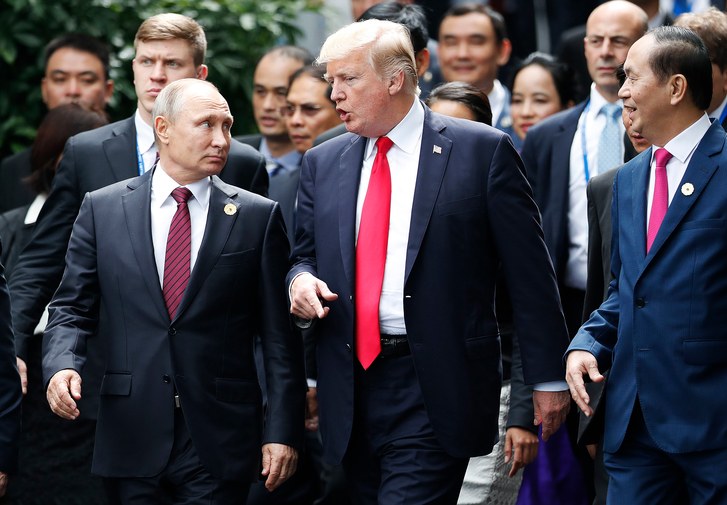
CheVaughn Starling is the host of Civil Diligence podcast. Hailing from a state called Illinois in America,her love for politics and history led her to aspire a career as a political analyst. CheVaughn was inspired by the idea to start Civil Diligence for a simple platform for millennials to express themselves politically.Out of all the political shows out in the world, there was not a true platform where millennials could speak their mind and ask questions about the political minutia that effects our world…and our pockets. She feels that if you are effected by the government, you should at least have the bare minimum comprehension of how the people we elect effects US.

Is Regulating The Internet Good For Us?

by Aliya Ismangil

This April, the government released a white paper introducing regulation of online media in order to mitigate ‘online harms’. The legislative proposals are up for public consultation until July 1st, when the government will then move forward with making any adjustments concrete and start the process of making it law. 

The paper outlines the scope of the ‘online harms’ it is intended to tackle, ranging from harmful and abusive comments, to terrorist activity and other illegal content such as child grooming and sharing of sensitive materials. The new regulatory framework will apply to companies that share or discover user-generated content and interact with each other online, “including social media platforms, file hosting sites, public discussion forums, messaging services and search engines.” The paper proposes enforcement of a duty of care by companies that provide such services that they are to make sure their platform or service adheres to. It mentions that such regulation will be carried out by an independent regulator, but such a body does not yet exist or been appointed. As well as proposing legislative framework, there is also mention of the intention to start media literacy programmes to ensure children and parents know how to navigate such ‘online harms’. 

With the rising concern over social media’s links to mental health, including some high profile cases, such as Instagram banning ‘explicit self-harm images’ after the death of Molly Russell, the Cambridge Analytica scandal and more recently the live streaming of a terrorist attack, this response seems inevitable. The internet has evolved greatly in the past decade alone and with it an exponential growth of innovation but also dangers. The newest craze of social media has both enriched lives and has been caused for concern. A 2015 report by neuroscientists shows that social media allows individuals to satisfy many social needs easily, and therefore the benefits it can bring to us humans. On the other side, the increased anonymity the internet provides has also provided the right ingredients for a hostile and abusive environment, and in some cases, a perfect platform for criminal activity. Social media and the internet is fast becoming an integral part of our society, if not already so. This white paper shows the Government is willing to step up and take the responsibility of creating a safer internet space for future generations.

Empirical research into internet use, especially social media use, and mental health is still relatively new in the science world, but there is already a good amount of research out there. An extensive review of the literature by researchers in 2018 has found that isolated and socially anxious adolescents are more likely to use the internet and online social networks. When taking this into consideration, it is easy to see how the content that they are shown can have a profound effect on their wellbeing. This certainly seemed the case with 14-year-old Molly Russell, who had been viewing social media content related to anxiety, depression, self-harm and suicide before dying by suicide. Her father’s fight to have more regulation over such sensitive content resulted in Instagram tightening up their content filtering and banning explicit images of self-harm.

The paper also emphasises the harms of illegal content, mentioning child sex offenders using “the internet to view and share child sexual abuse material”, as well as terrorist content. Again, from recent events it’s not hard to see how regulation could be a good thing. It almost seems unbelievable that the shocking and horrific New Zealand attacks were live streamed on Facebook with seemingly little interruption or flagging. Perhaps a legal framework would push big shot online platforms like Facebook to really invest their time and money into finding a solution to filtering harmful content. 

All this being said, it’s important to not lose sight of the many positives the internet has given us. As well as the negative effects, the 2018 survey of research finds there are many aspects of internet-use, combined with certain environmental factors, that benefits a person’s well-being. It will be another two years before the proposals in the white paper becomes law, and more time after that before implementation. The success of such regulation also depends on the regulatory body chosen to enforce the future legislation. I’d like to see more expansion and focus on media literacy programmes, especially for younger people. If this framework is going to achieve its goal in creating a safer, yet free, internet space, we need to change our internet culture to be so. If we’re going to do that, teaching future leaders is imperative. It is early days yet to say that this is certainly the regulation we need, it’s still very vague and under consultation. There is no doubt, however, the proposals will, and have, incited thought and debate over our Internet use, something that I think has been long overdue. 

Aliya is a recent Psychology graduate from The University of Manchester, where she was Science and Technology Editor for the student newspaper, The Mancunion, in her final year. She is now Digital and Social Media Intern at The University of Manchester.