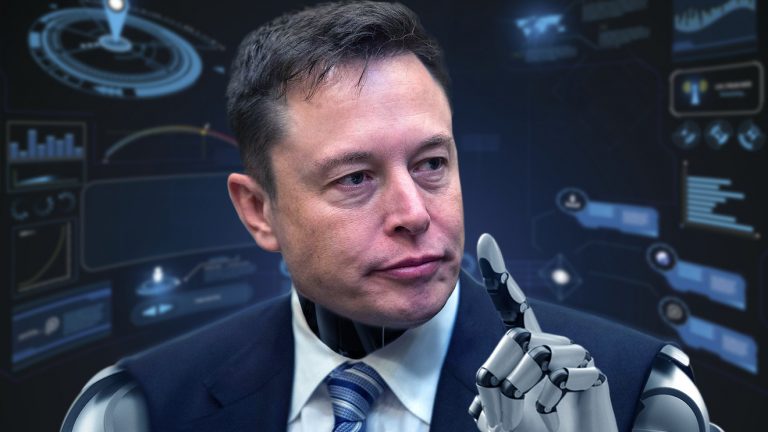
Meet Vernon Unsworth, reports say that his knowledge of the cave systems was integral in helping rescue the lost Thai Football Team last week. The British immigrant to Thailand had these words for tech-billionaire Elon Musk who had initially wished to shoot a five-foot submarine down the cave to rescue the boys and their coach:
https://www.youtube.com/watch?v=1TmjpIkVDrU
“He can stick his submarine where it hurts…it had no chance of working…he had no conception of what the cave system was like”. These strong words did not go unnoticed by the billionaire whose response shocked the world.
The now-deleted tweets read:
“Never saw this British expat guy who lives in Thailand (sus) at any point when we were in the caves. Only people in sight were the Thai navy/army guys, who were great…” – @elonmusk 15 July 3:56 pm
“You know what, don’t bother showing the video…sorry pedo guy, you reall didy ask for it”.– @elonmusk 15 July 4:11pm
Yes, you read that correctly the CEO of a publicly traded company, subtly, and then overtly called a man a pedophile for being a British national living in Thailand. While totally slanderous and probably actionable in a court of law (something that Unsworth is on the record for considering) it highlights a response all too common in our public discourse.
During the Common Sense Tour, we’ve often been asked, as an organization that defends the right to free speech, where we draw the line on objectionable speech. This, to me, is a clear instance of what surfaces on the murky, outer edges of free speech.
Musk threw out this baseless accusation, not in order to enhance the conversation that was taking place or to highlight his side of the story but to injure someone he disagreed with purely just to injure them. This nihilistic abuse of free speech should be completely condemned and I can’t imagine being upset if Unsworth receives a sizeable payout from the billionaire’s outrageous comments.
What do you think? Does free speech also include the right to assassinate someone’s character? Do you think Musk’s words come under character assassination? Join in on the debate on Twitter.
Summer has finally hit and for once the UK seems to be getting that good weather, which is usually unequally distributed in the Mediterranean. If you live by the coast, maybe if you close your eyes you can imagine that you’re somewhere that’s not boring Britain; but let’s be honest though, Skegness isn’t quite Sicily. If you’re a broke student like me or just hate spending ridiculous amounts of money on holiday’s you’ve come to the right place. Here’s a little insight on how to feed your travel addiction, without breaking the bank.
1. HolidayPirates
If the name scares you then so will these incredibly low prices. Once you get passed the dodgy sounding title, you’ll be planning holidays every month because everything is just so cheap.
Don’t you worry this isn’t a scam, I’ve booked a few holidays myself and can reassuringly say I’ve had nothing but good experiences each time. HolidayPirates works by finding the lowest deals on package holidays, flights and hotels. The deals don’t stop there, they run numerous competitions on a weekly basis, as if this couldn’t sound anymore unreal.
So, what’s the catch then, I hear you say? Nothing really … you just must be flexible. Most of these cheap deals run on certain dates, and whilst you may still be able book on your prefered dates-be prepared for the price to shoot up. Playing around with the dates isn’t always bad as most of the time the restrictions aren’t so bad and prices tend to stay relatively the same. My top tip is avoiding the school holidays, and stick to their suggested dates and you’ve got yourself a winner.
2. Au Pairing
This may be one of the best ways to travel with minimal spending on your part. Au Pairing is basically babysitting in a foreign country, but with free food, free accommodation and you get paid. Yes, the babysitting bit sounds like a drag but there’s ways around it. As you read this I myself am taking part in this in the beautiful city of Madrid. I work from 9-2 (if you can even call it work) my main role is speaking to the children in English. Many Au pair gigs hardly require major babysitting so if you’re not keen on spending 24hrs with a 3 year old, search for a family who require you more as an English teacher than a nanny. I organised my stay through www.aupairworld.com; all I had to do was make a profile, set my prefered location and home duties and watched as the messages of interest flooded in. This is probably my most favourite method of budget travel. Check out Youtuber Sasha Marie Marshall, who talks about her experience and how she set up her aupair exchange.
3. Skyscanner
When it comes to flights I’m always frequenting on Skyscanner. When looking for the cheapest flights there’s no better place. The website searches hundreds of websites for the cheapest flights for your specified destination. One general rule when looking for cheaper flights though is to stay away from the weekend and popular times such as school holidays.
The question of where to stay often presents as the most expensive part of the holiday. Whilst you can get cheap flights to European destinations for under £60, the hotel in the city centre may be £50 a night (if you’re lucky). This is why I never book with a hotel unless it comes in a package deal.
4. Hostels
Historically, hostels have gotten nothing but a negative reputation. A festering ground for hippie dippy individuals talking about the meaning of life, dirty shared bathrooms, and those odd sounds coming from the bunk bed next to yours. I don’t doubt that all of that is very true for low standard hostels, but the hostels I’ve stayed in have been the polar opposite to this nightmare. More often than not, hostels are as clean as those over priced hotels people insist on splashing their money on.
In Europe they may still be a little on the pricey side – ranging from £20-£30 a night, but on your trip to Asia you’ll be shocked to find them for less than £10 and still at the same standard. Sharing accommodation does have its perks – especially as a solo traveller. Hostels are a very social atmosphere and a great way to meet new people. But, if you really are against sharing then book yourself a private room and get the best of both worlds; privacy and cleanliness but also the social atmosphere of the hostel common room.
5. Couch Surfing
Firstly, you must erase the image of a “wife beater” wearing man lying on his sofa watching Jezza Kyle. Replace it with free accommodation and a local guide and you’re spot on. Couch surfing is when you temporarily stay in other people’s homes, typically for free. This isn’t for everyone for obvious reasons; staying in a random person’s house doesn’t necessarily sound like the safest option, but an option it certainly is. If you’re reluctant then maybe stick with a hostel or have a go when you’re not travelling solo and you have another person to help you fight your potentially murderous host (kidding). Check out www.couchsurfing.com for more information on getting free accommodation or if you fancy hosting instead.
6. Airbnb
My trip to Iceland was made significantly cheaper by avoiding the hotel route. Airbnb has a similar concept to couch surfing (minus the free part). This time you pay to stay in someone’s house, with your mind at ease knowing that the owner of the house isn’t staying with you. They either stay somewhere else during your stay or live in separate quarters of the building you’re renting at the time. For a solo traveller, a hostel is more often cheaper but if you’re travelling in a group, large savings can be made. If the host allows more people than the bed space allows; for example, you could book an Airbnb that sleeps 4 but have a group of 6, so 3 share a bed rather than 2 with the 4-bed accommodation is likely cheaper than a 6 bed. Yes, this might not be the most comfortable but when you’re working on tight budgets sacrifices must be made. For 6 days in Reykjavik between 6 of us it cost us a reasonable £100 for accommodation (£20 per night).
Finally, for an added bonus on making savings I suggest watching the “budgeteers” a youtube channel dedicated on budget travel – hense the name. They were were probably one of my main inspirations to travel and really show that travel doesn’t cost a fortune.
Happy travels!
Tanya is currently studying Biomedical Sciences at the University of Manchester and hopes to pursue a career in science communication, media and African development. She is a lover of fashion, travelling and has a keen interest in racial-social issues. She enjoys learning languages, being fluent in two and is currently adding French to her resume.
According to Julian Barnes, The Man Booker Prize winner, books will soon need “trigger warnings” as some students do not like being faced with the ugly truth.
Over the last two years, a growing number of universities have introduced trigger warnings about distressing material to students and offered safe places in which certain behaviours are prohibited.
The suggestion was made after some undergraduates had taken to criticizing Gustave Flaubert’s Madame Bovary on the basis of the protagonist’s behaviour.
Barnes spoke at the celebration of the Booker’s half century at the Royal Festival Hall and said “I sometimes get exercised by our stories being put up for examination on non literary terms and trigger warnings and all that stuff.”
He also used an example of US students who hadcriticizedFlaubert’s Madame Bovary, who had said ‘I didn’t like it because Madame Bovary is a bad mother’. Barnes ultimately did not know how to respond as he said ‘I don’t know where to begin to unpick that’.
However, a play by Shakespeare called Titus Andronicus had been given a trigger warning from Cambridge University English faculty to a lecture discussing the play, as it would include discussions of sexual violence and sexual health. The play also containsdepictions of rape, murder and cannibalism.
Titus Andronicus
Barnes said to his audience at the Royal Festival Hall that “as for students asking to hear in advance the bad things that happen in Titus Andronicus, we might as well have a trigger warning on all great works of literature”.
An article written two months ago by Lori Horvitz discussed and gave a new perspective on whether books should come with trigger warnings.
Lori Horvitz who has taught literature, creative writing and gender studies for 18 years has never given or been asked to provide a trigger warning.
Some time last year she revised her curriculum and omitted books of a sexually violent nature except for one book she had assigned but hadn’t finished reading. The book contained a gang rape scene from the perspective of a young child.
A student in an anonymous teacher evaluation, wrote ‘Not providing trigger warnings is not only detrimental to a student’s emotional well being… but it also represents further invalidation/insult of rape survivors.’
As a courtesy, she has begun to provide content warnings on her syllabi, as there is no way to know which issues will be a mental or emotional trigger for students.
She said in her article ‘I understand the need, if possible, to emotionally detach when discussing and reading about difficult topics, but isn’t discomfort the place where real leaning takes place?’
Do you think we need trigger warnings?
Dolline is a traveller, journalist and blogger who has palate to try new things. She is a very spontaneous person; you might find her skydiving over the Kenyan coast or kayaking on Lake Como. She can be an over thinker who considers every outcome, but when she isn’t on analytical overdrive, she welcomes the unplanned and unexpected.Dolline is a very simple person who is up for a good laugh or snuggling up with a cozy book and enjoys living in the moment. Dolline also writes for her small personal blog called ‘Swatches of Beauty’ and contributes to a radio show called a ‘A Chat with Elle Celeste’.
Theresa May’s week could scarcely get much worse. Having taken her Cabinet to a retreat at Chequers to hammer out a policy on Brexit that would be satisfactory for all. Everything appeared to be going passably for once, with the Cabinet apparently falling into line over a ‘soft’ Brexit deal. The pro-Leave faction within the Conservative party appeared somewhat dissatisfied but not expressly so.
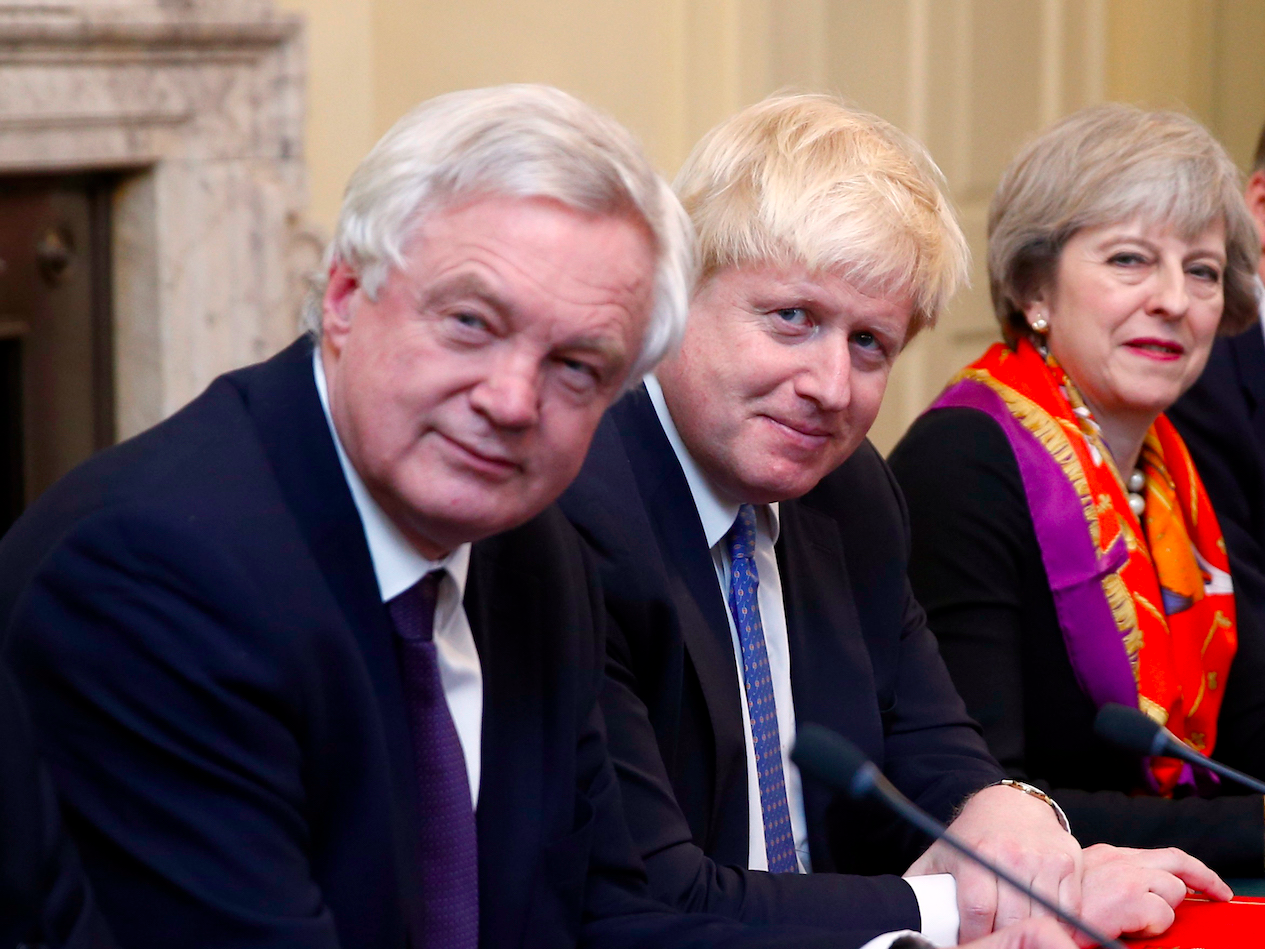
That was, at least, until the early hours of Monday morning, when Brexit secretary David Davis sensationally handed in his resignation with a strongly-worded letter to the Prime Minister, asserting that he could not support a policy that would leave the UK in a “potentially inescapable” negotiating position. He was soon followed by foreign secretary Boris Johnson, another Brexiteer who had long been at best an uneasy ally to May, as well as several other prominent Conservatives. If all this were not bad enough, she now has to entertain US president Donald Trump, a controversial figure at the best of times, while protests across the country threaten to flare up.
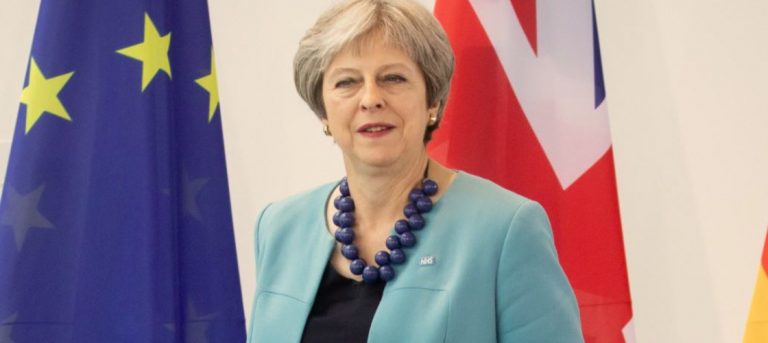
David Davis and Boris Johnson with May, the leader they deserted (Source: Reuters)
Given the departure of key members of her frontbench, who engaged in a public and stinging criticism of her policy, and a substantial wing of her party essentially in open revolt at such a key time for the country, many leaders would see no choice but to stand down. May appears a figure without authority, even within the Conservative Party, unable to exert control over the infighting over Brexit. And yet, it would be fair to say that May has survived worse.
It must be remembered that May made it through the debacle of last year’s election, where she staked her reputation on gaining a larger majority, only to lose it altogether. She also survived a horrendous party conference where everything that could possibly have gone wrong with her speech did go wrong. Compared to those disasters, losing two figures who have often been thorns in her side, and replacing them with arguably more loyal ones in Dominic Raab as Brexit secretary and Jeremy Hunt as foreign secretary does not see, fatal. With Parliament’s summer recess mere weeks away, any plots to remove her will either have to be rushed through, or risk losing momentum by waiting until MPs reconvene.
A far more serious threat to the prime minister may be posed when the time comes for Parliament to vote on the government’s Brexit deal. A defeat here would surely erode the last of May’s authority, spelling the end for her. If the deal looks anything like the white paper presented by the government outlining its negotiating strategy, May certainly cannot rely on those of her backbenchers supporting a ‘hard’ Brexit. Given her lack of a majority, any kind of rebellion from Conservative MPs would mean she has to rely on Labour votes. This approach, though, would be difficult for many reasons. Firstly, the Labour leadership would be highly unlikely to support May when given the chance to torpedo the government and take a step closer to power themselves. Secondly, Labour’s pro-EU backbenchers are unlikely to be satisfied with a deal which is not soft enough, and still distances the UK from the EU more than they would like. Finally, the thought of her ‘working with the enemy’ would enrage members of her own party even more, and may prove the last straw precipitating either a leadership contest or, even worse for May, the creation of a hard Brexit-inspired breakaway party.
Seems to me that fragmentation of Conservative Party this morning means that any brexit plan under any leader (with possible exception of a ‘soft brexit’ version of Gove) will not command a majority in Parliament. Autumn election? Hung parliament again? Referendum v2? Any ideas?
May has clung on to the top job for quite some time now, despite controversy after controversy. But with no obvious way to force through the eventual Brexit vote in Parliament, the government’s Brexit plan, and her leadership with it, may come toppling down.
When Arsene Wenger announced his resignation as Arsenal manager, there was an undeniable sigh of
relief from the vast majority of the clubs long time supporters following his last ten years of mediocrity.
Nevertheless, some are weary of this change in light of Sir Alex Ferguson’s departure from Manchester united in 2013. The legendary scot, managed Manchester United from 1986 to 2013 which saw him win 38 major honours. Despite this, following Ferguson’s departure Manchester United declined and struggled to mount a title bid the following season with David Moyes. So, should Arsenal be worried with Unai Emery’s appointment? There is an understanding that simply changing managers after a long period of having the same one doesn’t equate to a smooth transition. Different coaching philosophies, tactics and player management, are some of the changes that may take years to implement properly.
Stephan Litchtsteiner, 34, Swiss international. Source: Arsenal.com
However, Mr Emery has started his tenure as Arsenal manager with a bang by signing Swiss right back Stephan Lichtsteiner on a free transfer from Juventus. There were some raised eyebrows due to his age, but the reality is Arsenal need some experience and leaders, considering that has been their Achilles heel for many years. Arsenal also signed Sokratis from Borussia Dortmund, the experienced 29-year- old centre-back from Greece. So, calls for leadership in the spine of the team has been met.
Arsenal have successfully completed the signings of Lucas Torreira and Matteo Guendouzi; both
are young midfielders from Sampdoria and Lorient FC respectively. Torreira, 22, impressed at the
World cup for Uruguay and is highly rated considering the bargain price of £26 million in
today’s football transfer market.
22-year-old Midfield maestro from Sampdoria, Lucas Torreira
Arsenal have made great progress in this year’s summer transfer window, despite having to let
go of Jack Wilshere to West Ham on a free transfer because of a lack of playing time in the starting
eleven. It seems like Arsenal were successful in getting all their summer business done before the new premier league season which starts on the 12th of August for Arsenal. In contrast, Arsenal under
Wenger have had quite a laid back approach in the summer windows. So will we see a rejuvenated
Arsenal? Only time will tell.
Daniel is currently a student studying mathematics with computer science at the university of Essex and has a strong passion for technology, specifically machine learning. Daniel is also interested in hip hop, Japanese culture and poetry and sports. In his spare time he loves creating websites and making music.
Unless you are still down in the dumps about England’s exit from the World Cup and have been avoiding public places (just me?), you may have noticed that a special guest is on our shores. The President of the United States, Donald Trump, has arrived for a 4-day working visit to the United Kingdom
The Donald Lands
Trump arrived at Stansted Airport, north of London, early Thursday afternoon. He was flown by helicopter to the residence of the US ambassador to the UK in Regent’s Park, central London, where a large steel security fence has been erected.
US President Donald Trump (R) and US First Lady Melania Trump (L) disembark Air Force One at Stansted Airport, north of London on July 12, 2018, as he begins his first visit to the UK as US president. / Getty Images
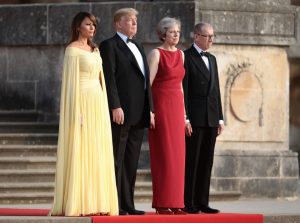
After spending some hours at Regent’s Park, Trump then attended a black-tie dinner, hosted by Theresa May at Blenheim Palace, the birthplace of one of his heroes, Winston Churchill.
The President was dressed in smart black tie for the event at Churchill’s birthplace, while his wife Melania donned a glamorous off-the-shoulder lemon dress. / Shaun Rider
A crucial moment for an administration in crisis, May has her hands full. She must steward our ‘special relationship’ under the gaze of European and indeed world leaders, consolidate the possibilities of a post-Brexit UK-US trade agreement, a crucial part of her Brexit plans, whilst making every attempt to be prepared for Tump’s characteristically erratic outburst and criticisms.
The Dinner
Speaking at the dinner, May repeated her desire to conclude a post-Brexit trade deal with the United States.
“As we prepare to leave the European Union, we have an unprecedented opportunity to do more. It’s an opportunity to reach a free trade agreement that creates jobs and growth here in the UK and right across the United States,” she said, in remarks released by Downing Street.
“It’s also an opportunity to tear down the bureaucratic barriers that frustrate business leaders on both sides of the Atlantic.” She mentioned thousands of US companies having offices in the UK.
“And the strength and breadth of Britain’s contribution to the US economy cannot be understated. The UK is the largest investor in the US, providing nearly a fifth of all foreign investment in your country,” she said.
Whilst May’s intention is clear, isolation is something she is all too familiar with. Her stance seems at odds with the general public.
Trump Not Welcome?
Whilst Trump is wined and dined in his reception with the Queen this afternoon at Windsor Castle, thousands of protesters are making placards, preparing to take to the street to show their dissent towards May and her governments’ position
Protesters preparing for Ani-Trump protests in the Capita / GettyImages
At least 70,000 people are expected to descend on central London to protest against Donald Trump when arrives in the UK for an official visit.
Demonstrators will make their way through the city on the “Stop Trump” march before a large rally takes place in Trafalgar Square. The organisers have described the protest as part of a “carnival of resistance” taking place across the UK in response to the US president’s visit.
A controversial blimp depicting Donald Trump as an orange, snarling nappy-wearing baby will also be flown today during the protests, outside the British parliament in London.
A six-meter high cartoon baby blimp of U.S. President Donald Trump is flown as a protest against his visit, in Parliament Square in London, England, Friday, July 13, 2018. Trump is making his first trip to Britain as president after a tense summit with NATO leaders in Brussels and on the heels of ruptures in British Prime Minister Theresa May’s government because of the crisis over Britain’s exit from the European Union. (AP Photo/Matt Dunham)
Blimp organiser Leo Murray explained that the giant balloon had been designed to speak to Trump “in a language that he understands, which is personal insults.”
Now, this blimp is not without controversy. It was crowdfunded by over 1900 people and will be flown alongside the protestors, however some have argued that it is in bad taste and paints a nasty picture of Britain. Here is one debate,
Sadiq Khan vs Piers Morgan
“I think they like me.”
When asked by the Guardian’s Ewen MacAskill how he feels about planned protests in London and elsewhere in the UK before his visit, Donald Trump insisted he was popular in Britain, citing his strong line on immigration.
But even Trump who routinely confuses delusions and reality cannot ignore the protests, public dissent and negativity which surrounds his visit here. Even though he will try to avoid hotspots of protest, the feeling in the air is palpable. One thing is clear, the British Public have strong feelings about Trump; ‘Like’ is not what I would call it.
Sebastian Vettel beat Lewis Hamilton on home soil to win what can only be called, a race for the ages. It started off with a disaster for pole sitter Hamilton as he was collected by Kimi Raikkonen at the start and was relegated to the 18th position. Force India’s Sergio Perez was another loser at the start, albeit on his own.
“I cannot be totally happy about today’s race. The incident at the start compromised my race: I lost the rear end trying to avoid the incidents ahead, spun and suddenly I was at the back of the field.” Perez said after the race.
Meanwhile at the front Vettel was in the lead followed by Bottas, Verstappen, Raikkonen and Daniel Ricciardo. Then a gap before Hulkenberg (who finished better than the rest), Leclerc, Ocon, Sainz and Kevin Magnussen completing the top 10. By this point Hamilton was on the charge clearing the Williams. He scythed his way past cars that were not supposed to be fighting him and was on the tail of Ricciardo by lap 10.
The first pit stops were underway by the 18-19 with the runners below 10th place staying out in the hope of gaining track position. Kimi Raikkonen meanwhile, had to pit as he got a 10-second timed penalty. That played well into his hands as Ferrari elected to pit him earlier than the midfield. He was behind Ricciardo by the end of the first round of stops. Verstappen got first priority and made his stop before his teammate. For those of you who don’t know, most teams elect to give the driver who is ahead on track the first choice in stops provided their pace differential is marginal. Hamilton and the runners who didn’t pit, made their stops finally pitted around the 21 mark.
This meant that Sauber’s points run came to a disappointing end. And it brought out the first Safety car. The battle down the field was boiling over with a chain of cars within DRS range of each other. Magnussen headed the train, followed by Alonso, Grosjean. Vandoorne and the two Williams’ were behind this train in a race far away. Then to trigger a usual presence (i.e the Safety car), the increasing entropy of the battle couldn’t be held any longer.
It was a racing incident but on further investigation the fault was with Grosjean who did not give Sainz room and lost control near the apex. Lap 35 onwards made this a classic. Hamilton and Bottas stayed out effectively gaining track position and were running 3rd and 1st.
It was a Mercedes 1 3 and a Ferrari 2 4. All to play for and 9 laps to go. Raikkonen was catching up to Hamilton on the slower tires. Vettel was right behind Bottas for the lead. After a few laps of defending, Vettel made a surprise lunge to take the lead. At the back, Ricciardo and Verstappen were duelling with Max spinning out and retiring due to a fault.
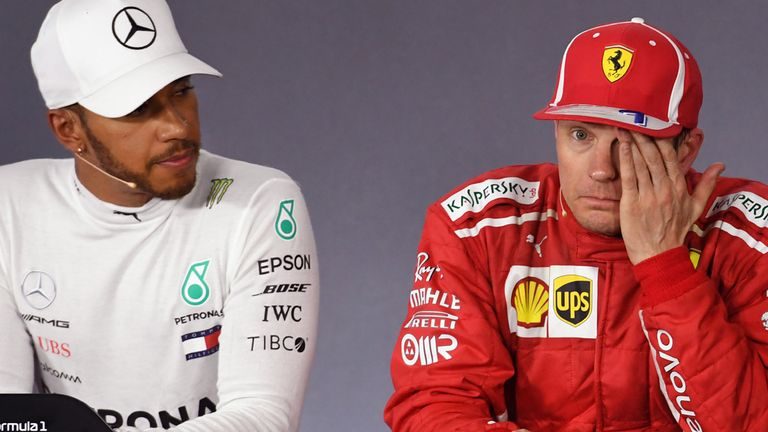
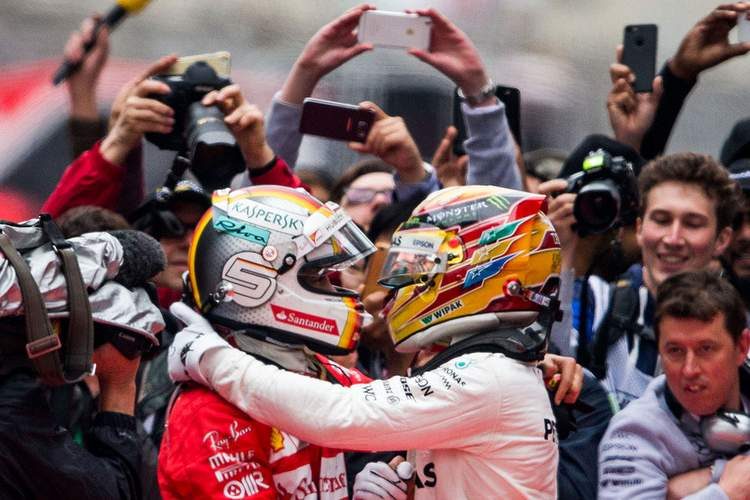
Bottas dropped down to 4th with Kimi muscling his way past. Vettel took the flag for his first win since 2009 and Ferrari’s first since 2011. Kimi completed the podium with Lewis who finished a sensational second and bagged ‘Driver of the day’. The post race debate was marred by comments of potential sabotage, with accusations that Raikkonen was either “daft” or was “deliberate” in taking out Lewis. Obviously those comments were absurd and both Hamilton and Raikkonen apologised to each other.
Hamilton and Vital in Shanghai in 2017
Vettel now seizes the lead yet again and in the process potentially dealing Hamilton a psychological blow. Hamilton isn’t one to back down from the challenge as the carnival heads to the returning German GP.
by Rutvik Bhaskar Perepa Rutvik Bhaskar Perepa is a student at The University of Manchester working towards a MEng in Mechanical Engineering hoping to be on a placement after Year 3. He has had the privilege to travel around his home country, India and discover the rich heritage and diversity. His personal interests include Food and travel, history, Sport among many others. Often found in discourse on various issues ranging Engineering to Religious Practices, he never shy’s away from being expressive. He believes in being open minded, empathetic and analytical is the key to problems posed on a daily basis.
We’re going to tell our children about the Summer of 2018. The Sun never failed us, every night ITV filled a Love-Island shaped hole in our hearts and, as it stands, 90 minutes against Croatia separate England from the World Cup Final.
Ladies and gentleman, it looks like this Summer is the Summer (if you forget about the mess that is our government right now) nothing can go wrong for England.
Here are a few reasons why we can say with a lot of confidence that football is truly coming home:
4 – Stephen Hawking’s Colour Hypothesis
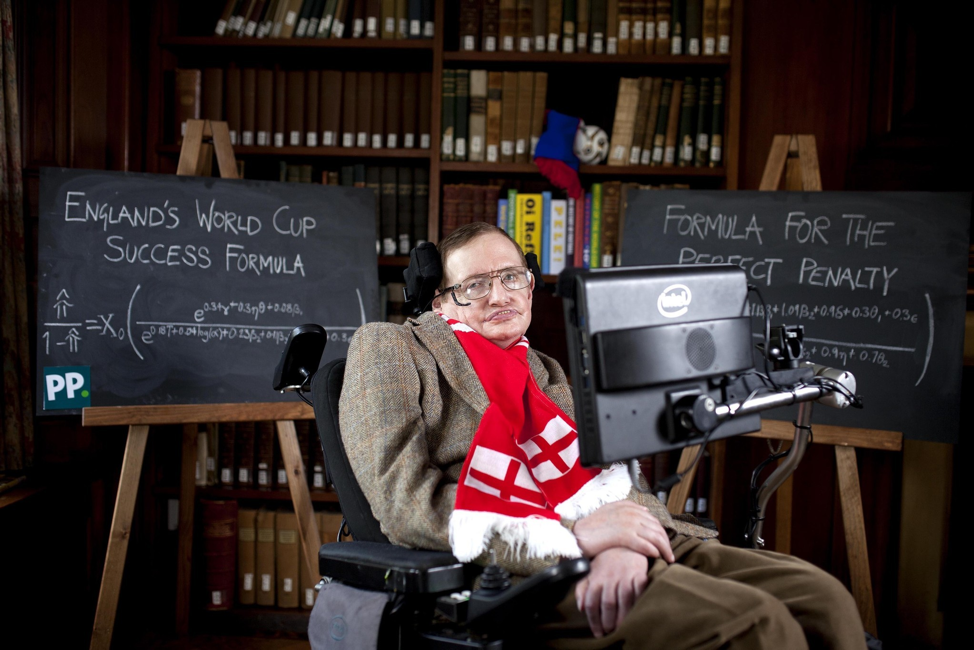
Ahead of the 2014 World Cup, the Nobel-Prize winning physicist Stephen Hawking attempted to put the ingredients of England’s success into numbers. One of the conclusions that he reached was that England was more likely to win when playing in Red – which is considered the teams ‘away from home’ kit and worn less frequently as the tradition all-white.
Source: LA Times
This year, that hypothesis rings more true than ever, with England wearing red in three of their 5 games, winning every single time they’ve played in away colours.
3 – Young Doesn’t Mean Inexperienced
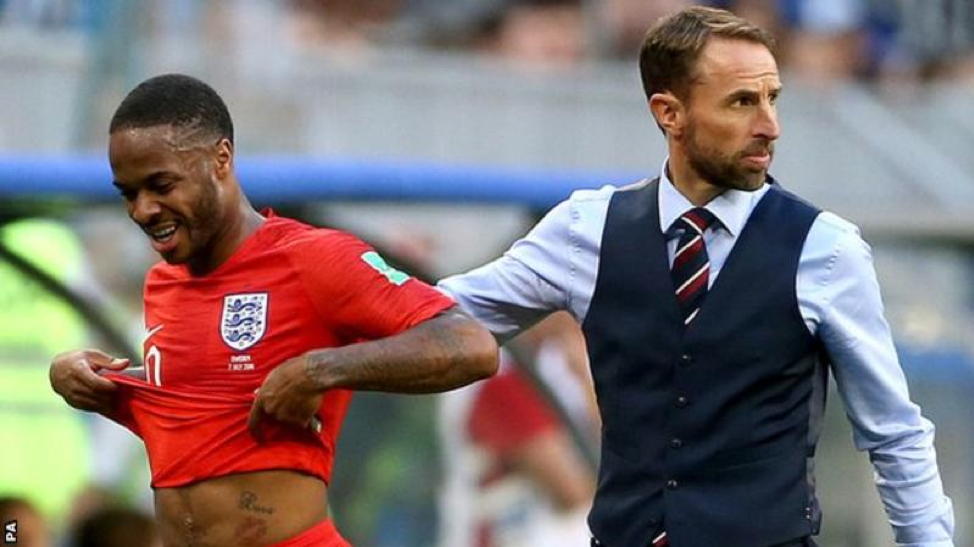
The incumbent Manager, Gareth Southgate is England’s youngest holder of that office, fielding England’s youngest team, and it’s no doubt that his input in crafting the England Youth System’s DNA Philosophy gave the young squad the confidence and cohesion that has seen them through this far.
Source: BBC. Raheem Sterling still catching flack from the media; less about his private life and more about his performance on the pitch.
DNA is a system of approaches and actions that range from a particular style of play (dominating possession, while being flexible, adaptable and quick off the ball) to the instilling of a sense of pride in the Three Lions and its heritage. DNA was something that Southgate was part of creating and it has filtered from the U21 Team right down to the most junior levels of FA football, creating uniformity even between players that have never played together.
Midfielder Dele Alli has commented, “I played with him a couple of times with the Under-21s, so I know his philosophy,” speaking of Southgate. Other players have similarly lauded how coming up through the youth system helped them slot comfortably into the National Team, which has not always been the case.
2 – An Easy Route to The Final?
Let's round up England and the World Cup.
We've played nobody of note, got lucky, had an easy route to the semi-final.
Kane, Dele and Sterling have had no influence on any of the games played.
Dier's penalty should go down as a save because it wasn't placed well.
This World Cup has proved that the playing field at the highest levels of Football has begun to equalise and that teams can no longer run away with competitions, a trend that already emerged in the domestic leagues but now is becoming apparent internationally. There just aren’t many ‘easy’ teams to beat anymore and that should be a source of deep excitement for the footballing world.
Even the footballers have noticed that the ‘easy route’ hypothesis doesn’t quite hold up to the reality on the pitch.
“I think it’s very dangerous,” Alli told reporters on Saturday. “We have to approach every game like we’re playing the best team in the world. These are top sides. No international game is easy”.
It’s coming home not because it was easy, but because England performed in a difficult tournament.
Anyone saying England had easy fixtures needs to look at the German & Spanish World Cup campaigns. Games aren't won on paper.
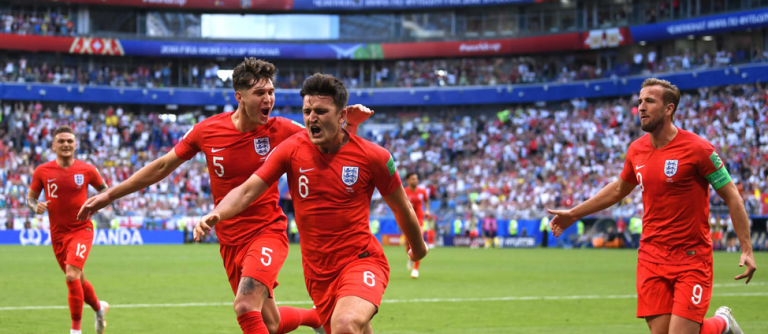
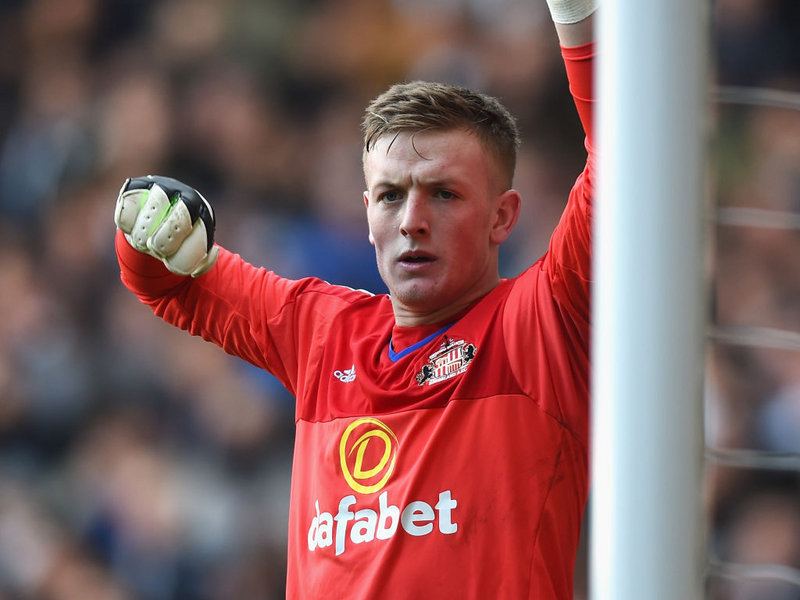
There have been some incredible individual performances from the England team: Goalkeeper Jordan Pickford could give the US President tips on building a wall that dispatches South Americans, Harry McGuire is now a national hero and the star of his own series of memes and Harry Kane, while blazing a path towards the golden boot has been less than selfish as a striker and an inspiring captain.
Jordan Pickford
The players have inspired the nation, who have in turn inspired the team in their own right. Social media in England has appropriated the “It’s Coming Home” mantra that comes from the 1996 song by the Lightning Seeds. Often, the song has been used sarcastically but this year marks a rare instance where the country is united by the prospect that England could really bring back the Jules Rimet trophy to the country where Association Football was born in 1863.
The Country seems absolutely united in goodwill for the team and the team must feel much more spurred on than previous England squad that were routinely subject to “so many jokes” and “many sneers”, to quote the song.
Well, most people are united:
A man called in to say he wants England to lose because there are too many black players ???? do you know this level of racism and mental illness pic.twitter.com/3OhHmkdhId
These days brands seem to be trying (and failing) to meet the mark where inclusivity is concerned. From FashionNova who launched their menswear line to In The Style with their “WeHateJosh” discount code inclusivity seems to be the new black. However, in the midst of all of this, ASOS may have actually cracked the code.
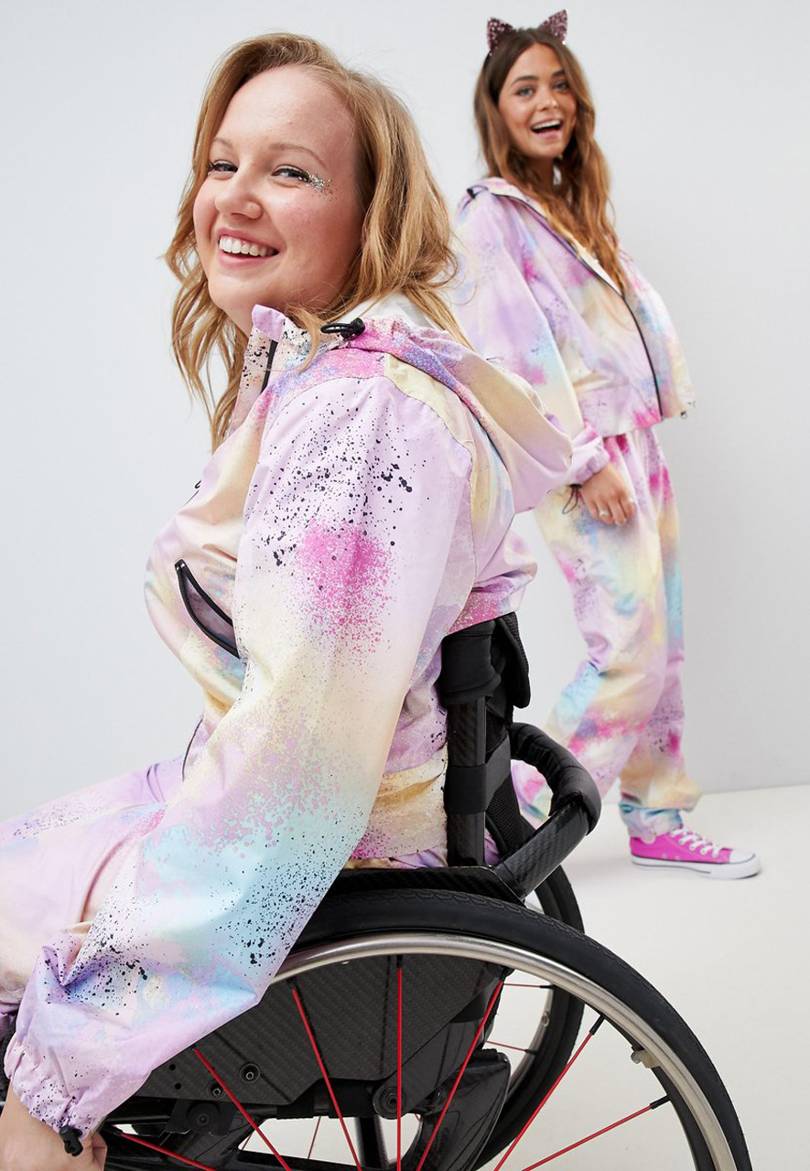
In collaboration with Team GB Paralympic athlete and BBC Bristol sports reporter Chloe Ball-Hopkins the clothing line designed a waterproof jumpsuit, ahead of festival season, that is also wheelchair friendly.
Chloe was born with Arthrogryposis which meant that she was born without hips. The condition also means that her shins are also affected. Though she has had surgery, Chloe spends the majority of her life in a wheelchair. She expressed that this made shopping difficult as it was hard to envision what the model was wearing on herself in the chair.
Chloe has shared that she got the idea after being drenched at Splendour Festival the previous year with her boyfriend and feeling as though it left her looking “like you’ve taken your gran out of the care home for a day”. She emailed ASOS hoping that they would be interested in the idea but assuming that they would take the idea themselves and expand on it, what she didn’t expect was that they would actually work on it together and that she would go on to be one of the models advertising it on the ASOS website.
The idea behind the jumpsuit is about making fashion accessible. There aren’t two separate designs for people who are and are not in a wheelchair, instead it’s one design that is able to work for everyone.
So over the last several months I have been working with @ASOS to create a fashionable, yet practical waterproof all in one! Not just for people like me in a chair but for anyone. It's about making fashion accessible! So what should be next?! https://t.co/1gzzkRlED9pic.twitter.com/7yS57QEmpD
— Chloe Ball-Hopkins (@chloe_ballhopzy) July 4, 2018
The jumpsuit is waterproof with a waterproof pocket on the breast, as opposed to being at the hips where pockets are often found, to store important things such as medical information and phones. It has cuffs on the feet which Chloe says make it ideal for people with different heights and even “means its easy to put wellies on”. It also has a zip around the waist which makes it easier to put on or take off despite being an all in one piece.
This of course is just the latest step towards inclusivity taken by ASOS. They have previously taken a stand against airbrushing the stretch marks on their models and they have also been credited as being excellent with the diverse hiring of their models as they hire people of different races, sizes and differing body shapes. Their Curve range was dubbed the most fashionable plus size range by Cosmopolitan Magazine.
ASOS are not the first big name brand to create things that are disability friendly. In November 2017 Mindy Scheier, founder of non-profit organisation “Runway Dreams”, an organisation that aims to educate the fashion industry about changes that can be made in order to become more accessible, gave a Ted-Talk in partnership with Tommy Hilfiger where she talked about how there are 1 billion people in the world that experience some form of disability. Tommy Hilfiger were the first mainstream brand to actually launch a clothing line for children with disabilities then went on to expand that line to adults. Amongst other retailers who have gone on to take similar steps are Nike and American retailer, Target.
The jumpsuit is available for £50 from the ASOS and can be purchased here.
Millennials today are often considered the ‘hyper-sexual’ generation. With attachments to alcohol, drugs and an unstoppable desire to be sexually active, it wouldn’t surprise anyone if you said they were the most sexually active era to date. This doesn’t just include intercourse but also ‘presenting’ oneself in a more sexual way through clothing and the sexualisation of television, media and so on. As the years have gone by, sex is arguably (at least in the western world) becoming less and less taboo, so why wouldn’t sex become a more frequent act, considering the rise in protective measures etc.? However, that doesn’t seem to be the case. Paradoxically, according to several studies across the UK and US, millennials (people born between the late seventies and the mid-nineties) are having less sex than the past few generations!
Generation groups aren’t categorically defined and so tend to go up and down in years.
According to the CDC report in the National Health Statistics Report which evaluated data on the sexual activity of those who were teenagers during 2011 to 2015, of those aged fifteen to nineteen, 42% of women and 44% of men reported that they were sexually active which showed a decline when compared with the 51% of women and 60% of men who reported being sexually active in 1988 in the US! A similar trend is found in the UK which has seen one in five sixteen to nineteen year olds with no sexual partners at all and subsequently a decline in teenage pregnancy according to the Director of External Affairs at the British Pregnancy Advisory Service.
Let’s explore possible reasons for this surprising decline
1. Sex Education and Consent
Beyond the classroom, people of all age ranges, from teenagers to adults, are being educated about the pleasures and dangers of sex through the media. Debatably, sex has become something that is more openly discussed. One thing now being widely explored is what consent actually is. With the #metoo movement revealing people’s stories of sexual assault and more adverts explaining how to ask and know whether someone is giving consent, it is possible that people are becoming more understanding of which boundaries not to cross in the bedroom department. This may have been followed by the decline as people are becoming more cautious with sex, what can be considered as going too far and others feel less pressured to go through with sexual acts.
This is a positive linking to a lack of sex as it shows that people are becoming more sexually liberal and taking a more methodological approach to sex, in that people are understanding what they want, how to express it and when to step back from a situation.
There are also more forums online and an extensive amount of videos (on sites like YouTube) which discuss how to know when you are ready to become sexually active, possibly meaning that people are being more careful and having sex when they actually feel ready to rather than misinformed or pressured.
2. Digital Age, sexual exploration beyond bedroom gymnastics
Technological solitude may also be a reason for the decline in sexual escapades of millennials.
I am often witness to hearing older generations talk about how young adults cannot be pulled away from their phones, computers or anything that can connect to some sort of social media network. We are consumed in a world of social feeds and Netflix and as a result, have had to sacrifice some intimate time with potential sexual partners. This to some extent seems to be true and could explain the drop in sexual intercourse.
Furthermore, quenching one’s sexual desires have never been easier than now and in the last thirty years. Not only is pornography accessible online (though pornography has always been available,having it online means access is easier and more discrete), sex toys more and more readily available through delivery and some people opt for sensual actions through online platforms such as video calling and sexting.
This may have led to the supposed decline in sex due to sexual intercourse being less convenient as it arguably gets in the way of the ostensibly fast moving environment of this new era. When pleasure is now so effortlessly attainable, why spend time finding someone to do the deed with or even who has time for the commitment and responsibility required in a romantic relationship?
Is technological advancement replacing our need for human contact?
3. A fear of intimacy and contact in the new age?
Image. That’s what it seems to all be about these days. We can deny the control that images of seemingly flawless men and women plastered and broadcasted over the internet, magazines and television have on our ability to be comfortable in our own bodies all we want, but that doesn’t mean that they don’t. According to British surveys conducted during 2014 and 2016 (according to one of the latest “National Survey of Sexual Attitudes and Lifestyle” and “the British social attitudes survey of 2014”)ten million women in Britain are depressed by their image and 8% of men and 44% of women experience anxiety during sex. Now it might seem to be a superficial worry however, this is something that should be taken pretty seriously, especially if body image and comparing oneself to Instagram “baddies” is causing a lack of confidence in the array of body shapes and types which we possess. Who knows what these images are doing to our mental health?
Apps such as Tinder and Grindr are suggested to have contributed to a ‘hook-up’ culture which is believed to encourage a rise in one-night rendezvous and casual partners. However, these online platforms may be having (slightly, for some) the opposite effect.
The kind of connection one can make online and the ability to allure behind a screen is one that cannot be easily re-enacted in real life. Fear of not being perceived in the same way in reality as online visually and in conversation may drive people to remain behind the screens.
The digital age also has contributed to a fear of intimacy and people are becoming more comfortable contacting others through digital waves than in real-life, as for someone who spends a lot of time online, the latter may seem debilitatingly daunting.
There are of course many more reasons why millennials are abstaining from sexual relationships; from the economic climate meaning that they will be at home longer into adulthood (lack of own space equals lack of opportunity to have sex), to the concern being more on making money and pulling oneself out of the seemingly crippling economy after the recession in 2008 and the possible decline while Brexit deals are being set etc., people seem to be more concerned about building a secure future rather than sexual exploits.
There are of course a couple of problems that come with research looking into sexual activity. The use of self-report techniques isn’t always reliable, despite the fact that we are constantly going toward sex becoming a less surreptitious subject. People still may lie about the amount or their frequency of sexual encounters for many reasons. In addition, the definition of sex itself is subjective, some may define sex as simply just sexual intercourse whereas others may include all possible sexual activities. Be that as it may, data does suggest that there is a clear dip in sexual activity for millennials and even Generation Z.
Whether it’s a problem that should be visited and studied with extreme precision or just a change of attitudes towards sex, one cannot be sure. However, reasons of why millennials are having less sex is probably very multi-lateral ranging from social media, finances and just a rise in more methodological thinking before approaching sex.
Benedicta is currently studying Arabic and French at the University of Manchester and hopes to become a linguist and broadcast journalist in the future. In her free time, she enjoys learning about African development and issues to do with race, society and culture. Benedicta also takes pleasure in acting, travelling and promoting plant-based eating.
Venezuela was once the richest country in South America. It has some of the largest known oil reserves in the world and was seen as a beacon of progress in Latin America. However, the current president, Nicolas Maduro and his predecessor, Hugo Chavez, helped to see to it that this great progress was reversed, running the country into turmoil.
Venezuela’s President Nicolas Maduro, holding a copy of the country’s constitution, addresses supporters at the presidential palace in Caracas, Venezuela, after electoral officials declared he was re-elected on Sunday, May 20, 2018. (AP Photo/Ariana Cubillos)
The administration’s persistent socialist and authoritarian policies have ensured its fall from grace. Empty shelves, rampant corruption and smugglers depict a clear image of the turmoil. A recent university study showed that 90% of civilians were living in poverty last year with most of those surveyed having lost 11 kg in body weight.
A father and daughter rest while someone holds their place before sunrise in a long line to buy basic foodstuffs in Tachirastate, Venezuela. Shortage of such products as flour, milk and sugar have made life increasingly difficult for residents of Tachira, which has been a focal point for anti-government protests for almost a month.
Senior economist at Pantheon macroeconomics, Andres Abadia, labelled Venezuela a disaster area and added that as long as Maduro is in power, the economy will continue to collapse. With all this chaos happening, there has been a deafening silence from his supporters including the incumbent leader of opposition in the UK parliament, Jeremy Corbyn as well as renown supporter and retired MIT professor Noam Chomsky.
As Venezuela descends into chaos there is dead silence from all the leftists from @MMFlint to Sean Penn who cozied up to Hugo Chavez
The country’s inflation rate has now hit 41,838% yearly for the first time according to Steve.H. Hanke, an applied economics professor at John Hopkins University who has tracked the country’s prices for the past two decades.
The country’s failing government blames the poor economy on opposition activists and the U.S government. The country’s president blamed the hyper-rise in prices on “criminal mafias”, but nothing could be further from the truth: Maduro’s administration has accelerated its spending while the country’s revenue sources were rapidly shrinking causing them to sink deeper into an economic crisis.
A little girl sleeps in the children’s cancer ward at Luis Razetti Hospital
Venezuela’s foreign exchange reserves have fallen by about $2.5 billion in the last three months according to Capital economics, leading to a further loss in value of the Bolivar, the country’s official currency. “Everyone who has a bolivar wants to get rid of it like a hot potato because they expect it’s not going to be worth anything tomorrow.” Hanke added.
Shafiq is a Chemical engineering student at The University of Manchester and has a strong interest in philosophy and history having been exposed to such issues at a very young age. He is also very keen on topics concerning the global economy, politics, and social issues, but when he’s not engrossed in such conversations, you can find him supporting the Barcelona football team or writing contributor articles for The Common Sense Network.
“It is impossible to lead a happy life when long hours and overexertion become routine; overworking must not persist in our society”. This was the statement made by Moon Jae-in, the South Korean president earlier this year who was introducing the idea of reducing the work week in a bid to boost the nation’s falling birth rate and depressing standards of living of its citizens.
His comments come as no surprise as South Korea’s fertility rate of 1.2 children per woman (The U.K rate is about 1.8) coupled with Spain and Italy, is one of the lowest birth rates among OECD countries.
This low birth rate is mainly blamed on the work culture, where people work very long hours, in fact in March this year, the gender equality and family minister, Chung Hyun-back, called the country’s working hours “inhumanely long” and put the blame for low pregnancies on the workaholic life.
But it’s not only government officials complaining about the country’s long working hours. A 2014 hit song, “Misaeng” that translates to ‘Incomplete life’ highlighted aspects of office life: Bullying from co-workers, sexual harassment and a cruel pecking order, were among the many troubling issues.
A young business woman in Seoul
However, changing the workaholic culture isn’t going to be an easy task for the government. The culture has been instilled into many South Koreans during the country’s 60-year rise from a poverty stricken nation to a leading industrial power. Such a change is inevitably going to take a tremendous amount of time as this requires a dedication of citizen’s priorities and values. Poverty has plagued this country for a considerable length of time and it is possible that the fear of backtracking from their new found success is affecting people’s relationship with work and as a by product, their perspective on family life.
The government has proposed a reduction in the official corporate work week in order to give employees more free time, improve their health and wellbeing as well as boost their birth rates. The work week for office workers was cut from the current 68 hours to 52 hours even though some believe that such a change will just remain on paper and won’t be promoted in most work places.
“A law on work hours is just a piece of paper, the reality in Korea is that we will work and work and work” giggled Hyun- Soo, an accounts assistant at a major telecommunications company while taking his smoke break. He preferred not to mention his name or employer due to fear of blowing his career.
Cheonggyecheon Stream In Seoul City
In order to comply with the new reductions, some companies have gone as far as deciding to shut down computer networks to force employees to go home early whilst others have installed TV surveillance to ensure clock-in and out at reasonable hours as well as introducing card swipe systems to limit smoking and coffee breaks.
A further measure of bettering standards of living has been the minimum wage increment; the South Korean government has also increased the minimum wage to $7 which represents a 16% jump. This minimum wage increment has been the biggest change in the last two decades as well as starting new programs to cut down costs for small businesses.
So how well will these measures work, and how far is South Korea prepared to go to ensure it doesn’t fall prey to an aging generation whilst on the trail of enconomic success?
Shafiq is a Chemical engineering student at The University of Manchester and has a strong interest in philosophy and history having been exposed to such issues at a very young age. He is also very keen on topics concerning the global economy, politics, and social issues, but when he’s not engrossed in such conversations, you can find him supporting the Barcelona football team or writing contributor articles for The Common Sense Network.
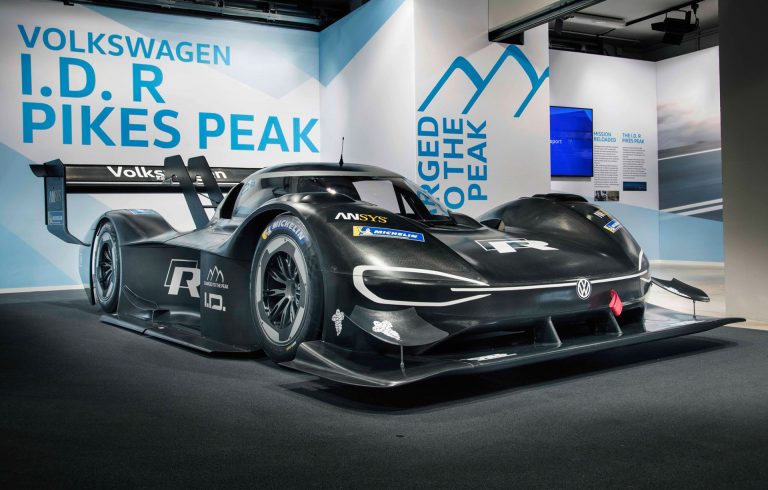
The Pikes Peak International Hill Climb is an annual Automobile and Motorbike event held at the Pikes Peak course at Colorado, USA. It involves drivers racing their vehicles to the top of the peak essentially making it a hill climb. One can imagine it’s similar to the timed attempts at the Nurburgring with the exception of it being a start to finish course and not a circuit (and of course the obvious hill element). Another feature is the fact that each driver is only allowed one race attempt and a few test attempts. The weather changes in this hillclimb can be drastic given the setting.
As you can see, in the image above, scaling this gaudy monstrosity within ones motor vehicle class/type is a an achievement in its own right. But being the fastest overall among all the vehicles that competed here since 1916, is nothing short of special.
In October last year, when Volkswagen Motorsport director Sven Smeets was interviewed, he spoke of the race as being a “new beginning for us. We are developing an all-electric race vehicle for the first time. The project is also an important milestone in our new motorsport orientation.”
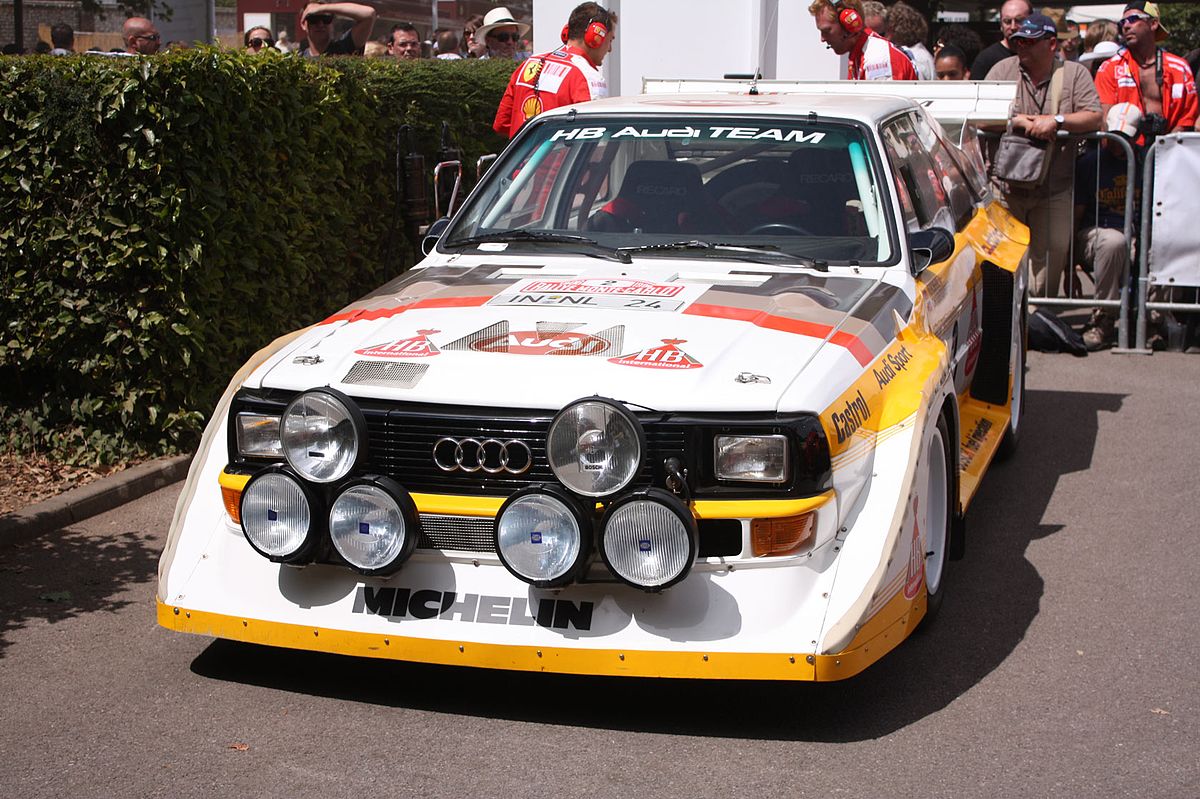
In short, this is a fresh direction post the emissions scandal. The glaring issue was the fact that Volkswagen had no experience racing at high altitudes. Their last attempt was all the way back in 1987. At that time the course was part gravel, one that required the terrifying and bonkers group B rally cars. To put simply, normal racing tires and cars don’t do quite well in gravel as compared to asphalt due to the varied traction requirements i.e much lower than normal. So we need specialized tires for starters. Secondly, as we climb up rapidly, the engine is starved of air as the air gets thinner and thinner. So without forced induction an Internal Combustion Engine would drop performance in said circumstances.
Audi Sport Quattaro – a group B rally car
Volkswagen Solution
Volkswagen’s solution was to get their MK2 Golf, one with an engine in front and another engine out back, making this a one of a kind model. Both engines were based on the 16-valve, 1.8-liter four-cylinder units then offered in the GTI. Each carried a turbocharger, and had a mechanical throttle system that would link their outputs as necessary; the driver could choose rear, front or four-wheel drives. And that output was massive – 652 horsepower, enough even with the weight of two motors to catapult the Golf from rest to 62 mph in 3.4 seconds. A 4-wheel drive mode would come in handy during the gravel section per se, so their machine and its flexibility was optimum at the time. During their run, they were leading as well only for a suspension bearing to fail. That effectively ended their challenge.
Now we date to October 18, 2017; work on the factory entry into the Pikes Peak International Hill Climb since the ill-fated 1987 campaign began. Proven winner, Romain Dumas, was chosen to be the pilot. Norma, who have experience building Pikes Peak cars are called upon for a “team-up”. An electric drive train was chosen and experienced technical director François-Xavier “FX” Demaison was at the job. Demaison’s key philosophy being downsizing, i.e reducing weight.
The Science
From an Aerodynamic standpoint, we would have to revisit the characteristics of air at high altitudes. Air becomes less dense as we get higher and higher and the pressure drops. This means beyond a certain point one would have to consider the fact that simulating this in a tunnel would not be possible. Hence the involvement with Ansys makes a lot of sense. The car trades off drag with Downforce, and as we go higher the effect of drag is reduced. An emphasis being placed on cornering and acceleration. As far as efficiency of the cooling cycle goes, it is slashed significantly as the air gets thinner.
“We could not manage this solely with the data from the wind tunnel, where it is not possible to recreate the thin air,” stated Volkswagen Motorsport’s Technical Director, François-Xavier Demaison, in a press release on the I.D. R’s aero development. “The simulation was a great help in determining the dimensions required for the cooling system.” The emphasis on acceleration is due to the fact that in a hill-climb, it’s a matter of maximizing acceleration rather than top speed.
Limited development time (the I.D. R was greenlit in August 2017) meant rapid component prototyping was crucial to the car’s refinement on such a short time frame, forcing heavy use of 3-D printing, according to one of the project’s computational fluid dynamics engineers, Dr. Hervé Dechipre. “We printed about 2,000 parts,” explained Dechipre “In doing so, we saved a lot of time.”
The picturesque Pikes Peak, Romain Dumas during testing.
Now bear in mind, the electric record was held by the eO PP100, which raced with almost 1,600 horsepower and 1,859 pound-feet of torque. So a goal weight 10 percent beneath that of the 1,200-kilogram (2,646-pound) record holder was targeted, forcing added complications onto the battery capacity and weight calculations. To keep mass down, two electric motors were used (instead of four), and they are linked by a reduction gear to the traditional differentials at both ends. Regenerative braking would harvest energy during the race. There is no torque vectoring, just a motor and differential at each axle. Heat recycling tech, too, is absent. All in the effort to shed weight. “I always said the best car for Pikes Peak would be electric,” said Dumas. “You have to fight against losing power, brakes, and downforce [at altitude], but you don’t lose power with this car. I’m in love with this race, the mountain is so beautiful. It’s a kind of Nordschleife, but for sure with even more risks.” Pikes Peak’s weather can change violently in a matter of minutes or miles. Even in June there can be sun at the foot of the mountain and snow at the summit. It’s common for sections of the course to be enshrouded in fog.
Volkswagen and Dumas believed they could attain the electric record—maybe even the overall record. At the end video evidence proved it. They shattered the EV record by nearly a minute and the overall crown by 16 seconds.
To quote Colin Chapman, “Adding power makes you faster on the straights, subtracting weight makes you faster everywhere”. And we can only begin to marvel at engineering and racing to the extreme.
by Rutvik Bhaskar Perepa Rutvik Bhaskar Perepa is a student at The University of Manchester working towards a MEng in Mechanical Engineering hoping to be on a placement after Year 3. He has had the privilege to travel around his home country, India and discover the rich heritage and diversity. His personal interests include Food and travel, history, Sport among many others. Often found in discourse on various issues ranging Engineering to Religious Practices, he never shy’s away from being expressive. He believes in being open minded, empathetic and analytical is the key to problems posed on a daily basis.
The generation we live in today revolves around social media; the incessant calling out and cancelling culture perpetuated by social justice warriors. Problematic celebrities have their support retracted; politically incorrect comments have been slandered and recently I have noticed the increase in recognition of social issues such as misogynoir.
What is Misogynoir?
The word misogyny is a term that no doubt the majority of people can at least recognise if not define. Despite that, its counterpart Misogynoir which is combination of the words misogyny and noir, is a term almost exclusively only known by the black community – more specifically black women. The word was coined by queer black feminist scholar, Moya Bailey as a way to express the misogyny directed at black girls and women. Like many issues in our social media fueled generation, the term was popularised on twitter and this word was specifically brought to the forefront by @thetrudz.
Youtuber: Philosopher perfectly explains the term in her video:
1. https://www.youtube.com/watch?v=OT6VnLN1DfU
#TOTW: Misogynoir |What is it?
“Misogynoir is us being seen as the least attractive solely based on race […] Misogynoir is the fact that although we are always having these conversations about how women make 78 cents to the man’s dollar however black women actually make 67 cents to the white man’s dollar[…] Misogynoir is the fact at any given moment in America, 64 thousand black women are missing and no one says anything. Misogynoir is that black women are reserved the role of the ghetto side chick … the hypersexualised jezebel in all almost all media roles”.
The idea that black women are inherently more aggressive is central if not the most prominent and most recurring example of misogynoir. The use of carefully selected language has effectively curated a negative narrative. As a black woman I can’t count the number of times the phrase “angry black girl” has been thrown around. When describing other women of other races for the same characteristics we see more desirable synonyms used. For example, a fierce or confident demeanour in a black woman would be portrayed as “attitude” whilst in a Latina woman it would be described as “passion”.
How Misogynoir has been used on the Island
So if you haven’t been living under rock, you’ll either be watching love island or at the very least keeping up with the tweets about it. One of the love island contestants Samira Mighty (she’s black) has been subject to misogynoir countless times.
Love Island Contestant Samira has been subject to online backlash which many may agree is unwarranted and racially motivated.
It started from the first coupling. Every one of the boys who were Samira’s type on paper chose a different girl and Samira was forced to be coupled with A & E doctor Alex. Many viewers see nothing wrong with denoting lack of interest towards Samira as simply personal preference. But that isn’t the whole truth; black women, particularly those of non-Eurocentric features and darker skin tones seem only desired when hypersexualised, when it comes to men outside their race. What most people don’t understand is that attributing beauty or non-beauty to race is really part of social conditioning, and we have been conditioned to think that when you look more European, you have achieved the standard of beauty. Compliments (insults really) like “pretty for a black girl” only reinforce this idea and illustrate the thought pattern that black isn’t beautiful. As much as I wanted to be excited about a non-ambiguous black woman entering the villa (a sure sign for an increase in diversity) the niggling idea that the boys likely wouldn’t find her attractive because she’s black consistently played in my head.
Not pretty enough to date Chris Pine?
When Samira revealed she had dated Hollywood actor Chris Pine, she was met with heavy criticism and accusations. One viewer tweeted that she was lying and many proclaimied that she wasn’t attractive enough to date someone of such a status.
Twitter user accuses Samira of lying about her romantic relationship with celebrity Chris Pine
In some ways Samira’s situation draws parallels to Marcel, a black man in last year’s series who was also chosen last despite his (obvious) good lucks. However, Samira has the added strife of being a woman with not only her looks put to question, but her behaviour also unfairly scrutinised.
Most recently Samira was deemed manipulative and fake when warning Alex on his new love interest Ellie. Amber Davids, although claiming to be team Samira put her in her Muggy section of her love island column in the Sun. She was joined by annoyed viewers of the show who tweeted about how Samira was misleading Alex to save herself. Strange that no one batted an eyelid of accusation when Dani and Megan were bitching about 20-year-old Georgia.
Twitter user analyses Samira’s behaviour and some think such comments are rooted in stereotypes of black women’s character being particularly negative
Yet what was funny is that Samira was right all along. If anything, she is the one person in the villa who doesn’t step on egg shells when it comes to telling Alex the truth. Ellie was filmed talking to Alex about how she felt their relationship was robotic and a preview of the Monday night’s episode revealed drama between Alex and Ellie which Samira had warned of. Furthermore, Samira is deemed aggressive yet other contestants are described with positive alternatives for the same behaviour, as Chia highlights in her tweet.
Chia Tweet: Dani vs Samira
Samira has been neglected throughout the whole process. When new potentials for Alex walked into the house the islanders encouraged him, gave him style and girl advise and the nation rooted for him to find his love. During all of this Samira received no attention and romantic affection yet no one cheered for her with as much enthusiasm. Despite the islanders claiming Samira is their best friend, the lack of support she receives doesn’t reflect their words.
What’s also funny is that the producers probably thought that by putting Samira in the show, it was a sure way to tick of the inclusion or diversity box. But what’s the point of putting the token black girl in if you’re not even going to put someone in that finds black women attractive? Witcho Lavender perfectly outlines this.
Are producers simply ticking of their diversity box?
Yes, new boy Sam did choose Samira in the end but I’m still critical. My reservations lie from the fact that when he retold his list of top girls he liked, he didn’t hesitate with 1-3 but forgot Samira’s name asking the girls to remind them of it. Moreover, the sheer number of tweets supporting Samira likely influenced the producers to send in Sam to pick Samira. Many speculate he will recouple with Ellie and Alex and Samira will be right back where they started.
Misogynoir is very much not over but, one thing I do hope is that more and more people become aware of it through watching Samira’s treatment on Love Island.
Tanya is currently studying Biomedical Sciences at the University of Manchester and hopes to get into media and journalism after her degree. Tanya is a lover of fashion and travelling and enjoys fashion blogging and learning languages in her spare time. Right now she is learning French and Spanish.



 David Davis and Boris Johnson with May, the leader they deserted (Source: Reuters)