On Saturday, central London became the site of what organisers are calling a historic moment. The Together Alliance march, backed by around 500 groups including trade unions, antiracism campaigners, and Muslim representative bodies, brought a diverse crowd from across the country to converge on Whitehall near the Houses of Parliament. By the time the rally concluded, the event had generated as much debate about its own scale as about the politics it was meant to express.
Rally co-organiser Kevin Courtney told crowds gathered on Whitehall that half a million people had attended — what he described as the biggest demonstration ever against the far right. That number was disputed by the Met Police, who put the figure closer to 50,000, though officers acknowledged it was hard to reach an accurate count given how spread out marchers were across central London.
The ten-fold gap between those two estimates is not merely a statistical curiosity. It shapes how the event is remembered, reported, and used politically. A march of 500,000 is a movement. A march of 50,000 is a significant protest. They carry different weights in public discourse, and both sides understand that.
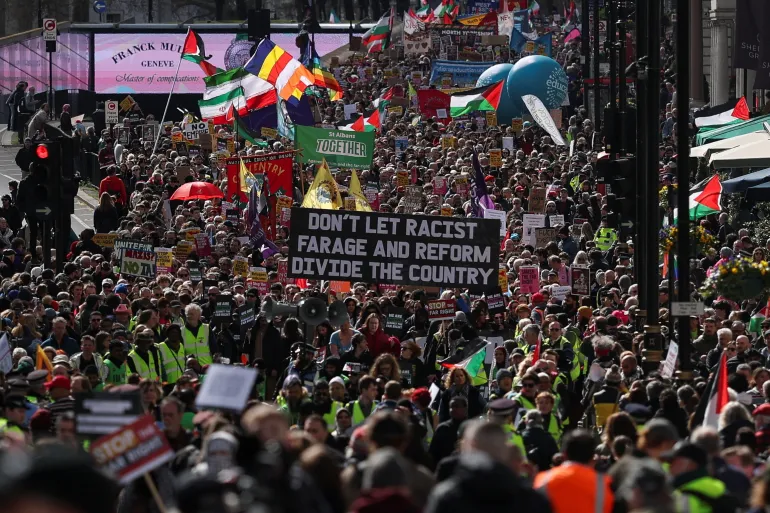
The march’s organisers framed it explicitly as a response to what they described as an “unprecedented growth” in support for far-right organisations, pointing to the Tommy Robinson-led Unite the Kingdom rally in September 2025 as the largest far-right mobilisation in British history. The Together Alliance’s stated aim was to demonstrate that their numbers were larger — and that the balance of public sentiment sits against the politics Robinson represents.
Speakers at the rally included former Labour MP Diane Abbott, who told the crowd it was the largest anti-racist march she had seen in her lifetime. Several other politicians attended, including Green Party leader Zack Polanski and Greater Manchester mayor Andy Burnham. The presence of elected figures adds a layer of institutional weight to what might otherwise be read as civil society activism.
The context in which Saturday’s march took place is significant. The march comes amid a surge in support for Nigel Farage’s Reform party and what campaigners describe as rising racism. A separate Palestine Coalition march also took place on Saturday, joining the Together Alliance’s route before both groups converged on Whitehall — a detail that illustrates how broad, and potentially complex, the coalition behind the event actually was.
What lies underneath this?
What the march does not resolve is the underlying political question it was trying to answer. Demonstrating in London, however large the turnout, does not straightforwardly represent the national mood. The areas where Reform and far-right politics have gained traction are largely outside the capital, in post-industrial towns and cities where frustrations about economic decline, immigration, and a perceived lack of political representation have built over decades. Those grievances do not disappear because a large crowd walked through Whitehall.
At the same time, the scale of Saturday’s turnout, disputed as it is, reflects something real about the breadth of concern among a significant portion of the population. The Together Alliance brought together trade unions, faith groups, antiracism organisations, and ordinary members of the public who felt moved to show up in person. That kind of coalition-building takes effort and reflects genuine feeling.
Britain is in a period of political polarisation that shows few signs of easing. Campaigners describe a political landscape shaped by rhetoric and decisions that chip away at rights, expanding enforcement powers, and deepening polarisation.
Those on the other side of the argument would describe it differently. Both readings draw on real experiences.
The march will be claimed as a victory by those who organised it, dismissed or downplayed by those who oppose its politics, and largely ignored by the people it was meant to speak to. Whether it changes anything depends less on the crowd size and more on what those who attended do when they return home, in their communities, their workplaces, and at the ballot box.
That is, ultimately, where these questions get answered.